73 parts in grey plastic; 12 parts in clear plastic; self-adhesive canopy and wheel masks; markings for three aircraft options; clear plastic assembly jig (3 parts).
All new, high quality moulding; crisp and refined surface textures and detail; high quality decals; includes assembly jig.
Disadvantages:
End-opening box.
Recommendation:
Highly detailed, accurate and well presented, Arma Hobby's F4F-3 Wildcat sets a new benchmark for this important naval fighter in 1/72 scale.
Reviewed by Brett Green
Introduction
The Grumman F4F-3 Wildcat was developed in response to a 1935 U.S. Navy requirement for a modern carrier-based monoplane fighter to replace the biplane F3F. Grumman's original biplane proposal evolved into the all-metal F4F, which was selected after redesign to compete successfully against the Brewster Buffalo. Production began in 1940 at Grumman's Bethpage, New York factory, with later manufacture expanding to General Motors' Eastern Aircraft Division as demand increased.
Entering U.S. Navy and Marine Corps service in late 1940, the F4F-3 became America's principal carrier fighter during the opening months of the Pacific War. Although slower and less manoeuvrable than the Japanese Mitsubishi A6M Zero, the Wildcat possessed superior armour protection, self-sealing fuel tanks, rugged construction, and excellent diving performance. Skilled pilots exploited these advantages using tactics such as the Thach Weave, allowing Wildcats to inflict significant losses despite numerical and performance disadvantages.
Compared with contemporary Allied fighters, the Wildcat was less agile than the British Supermarine Spitfire and slower than the Curtiss P-40 Warhawk at low altitude, yet it excelled in carrier operations and durability. Against Axis aircraft, it outperformed the Italian Fiat G.50 and matched the German Messerschmitt Bf 109 in structural strength, although the Bf 109 generally enjoyed superior speed and climb performance.
As newer fighters such as the Grumman F6F Hellcat entered frontline carrier service in 1943, the Wildcat assumed escort carrier operations, convoy protection, anti-submarine patrols, and close air support roles. Its compact size made it particularly suitable for smaller escort carriers throughout the remainder of the war.
The Wildcat was gradually retired from front line U.S. service after 1945, although some remained in secondary roles for several years. Its combat record during the critical early years of the Pacific campaign secured its reputation as a dependable and resilient fighter. The Wildcat's legacy lies in buying time for Allied naval aviation and proving that robust design and effective tactics could overcome superior enemy manoeuvrability.
FirstLook
Arma Hobby released their 1/72 scale Expert Series FM-2 Wildcat in March 2020. This was followed by the lower spec and reduced price Model Kit series FM-2 later in 2020, with the next kit being their 1/72 scale F4F-4 Wildcat in September 2021, then an Operation Torch boxing in 2023.
The Wildcat makes another appearance here, but take note - this is an all-new kit. The two grey sprues and the clear parts have all been revised and retooled.
The F4F-3 is the first variant to receive this facelift.
Arma Hobby's brand F4F-3 Wildcat comprises around 73 parts in grey plastic, twelve clear parts, self-adhesive canopy and wheel masks, markings for three aircraft and a thoughtful three-clear piece assembly jig.
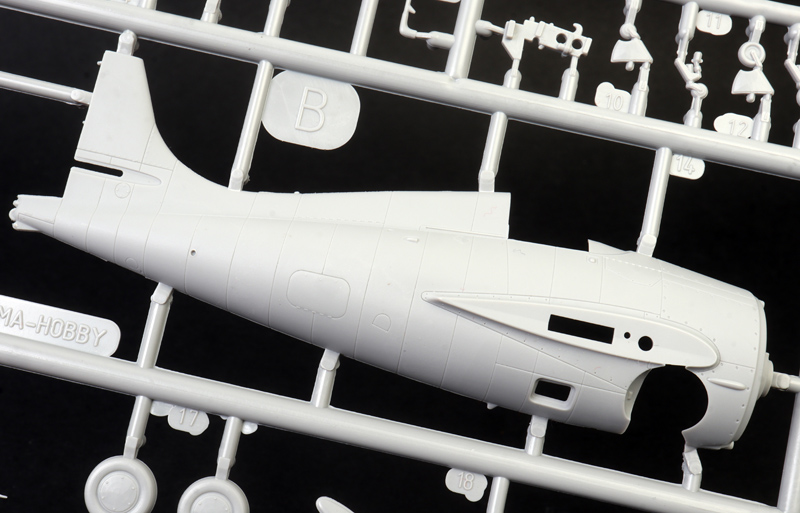
The grey plastic parts are delivered on two sprues. Moulding quality is excellent with no flaws or visible moulding imperfections on my sample, although there is flash on some of the parts. Arma’s website advises that long-run metal moulds are used for their kit production, and it really does show.
Being a long-run kit, the parts are moulded with all the alignment aids that you would expect including locating pins, holes and tabs.
The larger parts are moulded with a satin finish. Surface textures are just gorgeous. Recessed panel lines, raised fastener heads, blister fairings and other structural details are very fine.
The fabric texture on the rudder, elevators and ailerons are represented by subtly raised rib tapes. The elevators are moulded as a pair so they may be posed to taste. The rudder is a separate part too.
The fuselage is supplied as left and right halves with the standard fin moulded to the fuselage halves.
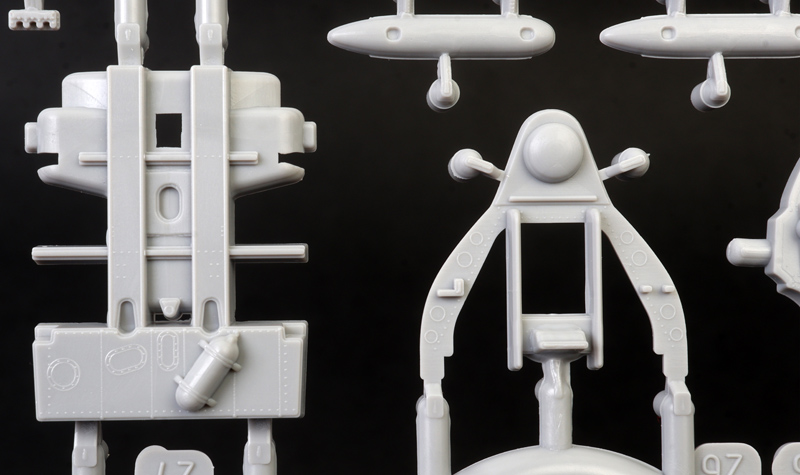
Some cockpit sidewall detail is moulded directly to the inside of the fuselage. There is also a plastic cockpit floor, front and rear bulkheads, side consoles, a moulded pair of rudder pedals that plug in behind the instrument panel, control column and more.
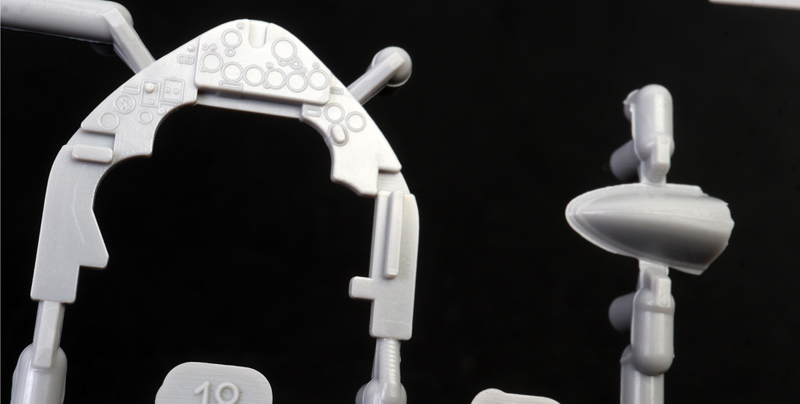
A plastic instrument panel is also supplied with raised bezels and switches. The decal sheet supplies a set of harness straps and instrument panel.
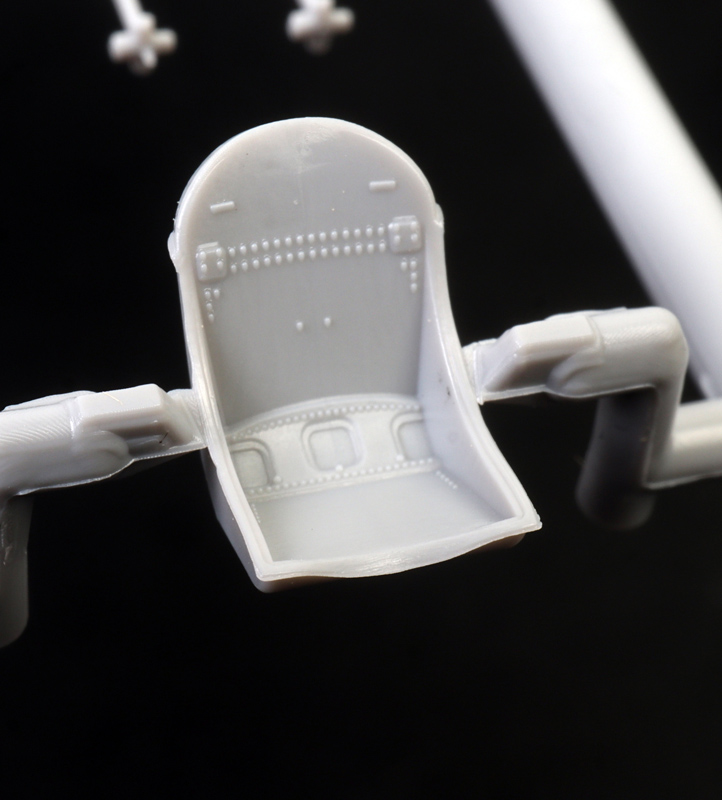
I particularly like the pilot's seat but really, all the cockpit detail is super crisp. It's had to believe that some of these parts are 1/72 scale.
Wheel wells are nicely detailed. The intricate landing gear is cleverly moulded in a minimum number of parts, although care will be required during alignment and assembly. Test fit thoroughly!
Two different tail wheel parts – covered and uncovered. The main wheels are subtly bulged and flattened.
The engine is very well done. The two row of cylinders boast fine cooling fin detail. Pushrods are moulded onto the rows of cylinders.
The wings are moulded in four parts with upper and lower, port and standard halves. Trailing edges are very thin – almost translucent.
Two optional wing-mounted bombs and racks wrap up the grey plastic parts.
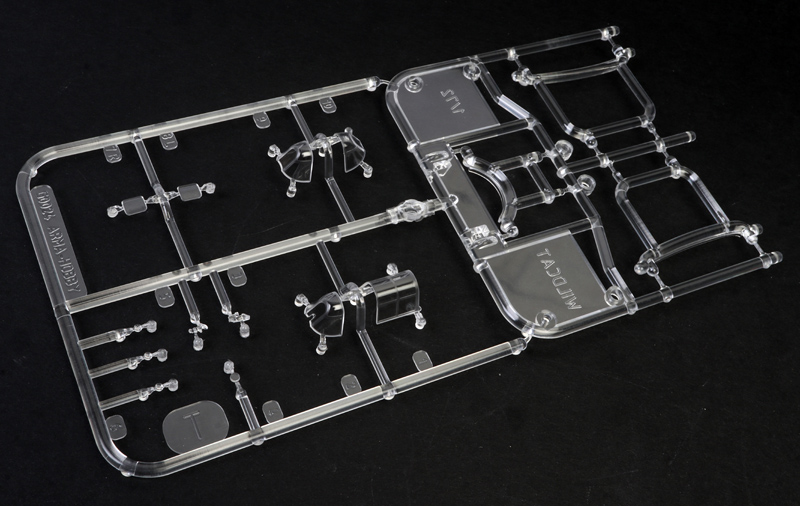
The canopy parts are thin and clear and offer separate parts for the windscreen and the sliding section. The gunsight lens is a clear part too.
Wing tip navigation lights are moulded as part of the wings.
A number of options are on the sprues including three styles of engine cowling fronts, two styles of crank cases (with and without magnetos) and tail wheels, but these are not used on this F4F-3 boxing.
Self adhesive masks are supplied for the framed canopy. This will be welcomed by modellers who dislike cutting their own masks.
Instructions are supplied as an eight page stapled A5-sized booklet. Some of the assembly sequences are a bit complex so make sure you test fit until you are sure where everything goes before you commit to glue.
The kit is packed into a end-opening cardboard box. I have to say that I have never been a fan of end-opening boxes - access to the parts is more difficult, loose parts can easily be lost while retrieving instructions or a larger sprue, and the format is less structurally rigid, inviting the contents to be crushed when the box is inevitably at the bottom of a pile of kits.
I know it is a nit-pick but I would prefer to see future Arma Hobby releases in a lid-style of box.
Marking Options
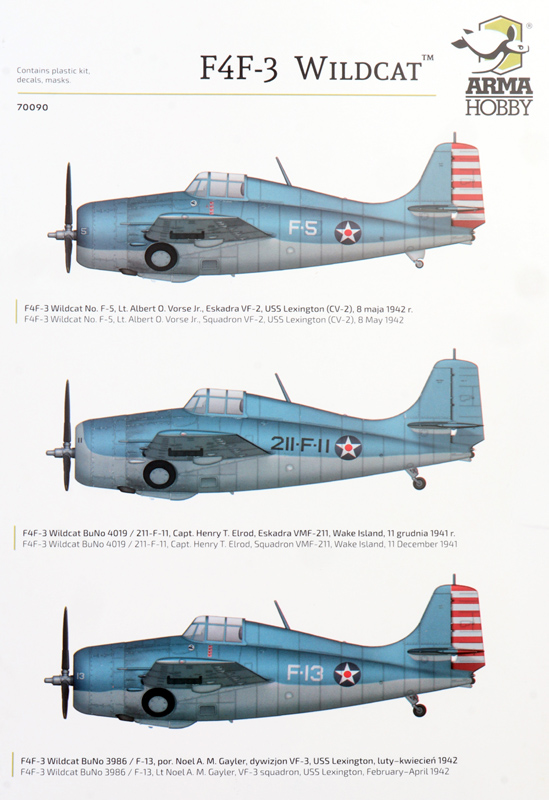
Three sets of early Pacific War markings are supplied. They are all finished in Blue Grey upper surfaces and Light Grey.
Details are:
F4F-3 Wildcat “F-5”, VF-2, USS Lexington, flown by Lt. Albert O. Vorse Jr., Battle of the Coral Sea, May 1942
F4F-3 Wildcat BuNo 4019 “211-F-11”, VMF-211, Wake Island, December 1941
F4F-3 Wildcat “F-13”, VF-3, USS Lexington, early 1942
Colour callouts are provided for FS numbers and model paint numbers from a wide variety of companies – Hakata, AK, Lifecolor, Mr Hobby, , AMMO, Humbrol, Vallejo and Tamiya.
Decals are printed by Cartograf. They are glossy, colours are well saturated and everything is in perfect register.
Arma has also supplied bonus decals for another four marking options. Instructions for these four bonus markings are included.
The three part assembly jig is a thoughtful touch too.
Conclusion
Arma Hobby has built an enviable reputation for producing some of the nicest 1/72 scale aircraft kits on the market, and this all-new F4F-3 Wildcat only builds on that standing.
Surface textures are restrained, the cockpit, wheel well and engine are exceptionally well rendered for the scale, and thoughtful inclusions such as canopy masks, an assembly jig and Cartograf decals add genuine value.
Careful test fitting will reward the modeller, particularly around the landing gear, but nothing here appears beyond the capabilities of a modeller with a little experience. My only reservation remains the end-opening box, a minor complaint against an otherwise outstanding package.
Highly detailed, accurate and well presented, Arma Hobby's F4F-3 Wildcat sets a new benchmark for this important naval fighter in 1/72 scale.
 Home
| What's New |
Features |
Gallery |
Reviews |
Reference |
Forum |
Search
Home
| What's New |
Features |
Gallery |
Reviews |
Reference |
Forum |
Search