Avia S-99 / C-10

Eduard Limited Edition, 1/72 scale
S
u m m a r y |
| Catalogue Number: |
Eduard Kit No. 2157 - Avia S-99 / C-10 Eduard Limited Edition |
| Scale: |
1/72 |
| Contents and Media: |
103 parts in grey plastic (many marked not for use), 26 parts in clear plastic; colour photo-etched fret with 28 parts; brass coated photo-etched fret with 34 parts; die-cut self-adhesive masking sheet; decal sheets with four marking options and stencils; instructions. |
| Price: |
USD$32.95 plus shipping,
available online from Eduard
GBP£17.40 EU Price (GBP£14.50 Export Price) plus shipping available online from Hannants |
| Review Type: |
FirstLook |
| Advantages: |
High level of detail; outstanding surface features including crisply recessed panels and subtle recessed rivet lines where appropriate; includes colour and brass photo-etched parts. |
| Disadvantages: |
None noted. |
| Conclusion: |
Eduard has once again made excellent use of its established 1/72 scale Bf 109 tooling, and the Avia C-10 / S-199 boxing adds an interesting post-war twist to the family.
The combination of finely moulded plastic, extensive photo-etched detail, useful options and four marking choices makes this an appealing package for both Bf 109 enthusiasts and modellers looking for something a little different.
Thoughtful touches such as the separate pitot tube and alternative plastic cockpit parts should also make for a straightforward and enjoyable build.
Highly recommended. |
Reviewed by Brett Green

The Avia C-10, later redesignated S-99, was the first post-war Czechoslovak development of the Messerschmitt Bf 109. It was essentially a continuation of the Bf 109 G-10/U4, using airframes and components left in Czechoslovakia at the end of the Second World War.
Most of these originated from the Wiener Neustädter Flugzeugwerke (WNF) production facilities, including the underground Diana factory at Tisnov, where Bf 109 G-10/U4s had been manufactured during the final months of the war. The surviving components were collected at Avia's factory at Prague-Cakovice, overhauled and assembled into complete aircraft.
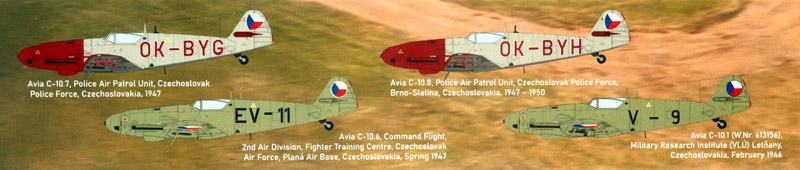
The first C-10 flew on 22 February 1946, powered by its original Daimler-Benz DB 605 engine. Twenty-one single-seat aircraft were eventually completed. Initially designated C-10 ('C' for cvicny, or training), they were operated principally by the Air Force of the National Security Corps (SNB), including border-patrol duties, while some were used for fighter-pilot conversion training. In May 1947 the designation was changed to S-99, with 'S' denoting stihaci (fighter).
The S-99's career was short. A shortage of serviceable DB 605 engines led to ten surviving aircraft being converted to S-199s with the Junkers Jumo 211F engine in late 1950. The remaining S-99s were retired during 1951, while the S-199 became the principal production derivative.
I believe this is the first time that Eduard has offered an Avia C-10 / S-199 boxing in 1/72 scale.
Of course, the sprues are the same as Eduard's lovely 1/72 scale Bf 109 G-10 kits, but that is by no means a bad thing!
Eduard's 1/72 scale Avia C-10 / S-199 package comprises 103 parts in grey plastic (many marked not for use), 26 parts in clear plastic, colour photo-etched fret with 28 parts, brass coated photo-etched fret with 34 parts, die-cut self-adhesive masking sheet, decal sheets with four marking options and stencils and detailed instructions.
Grey plastic sprues are labelled P, U and V, with the clear sprue labelled J. This is the same sprue arrangement as Eduard's 1/72 scale Bf 109 G-10 WNF / Diana offering. This also doubles as the G-14/AS.
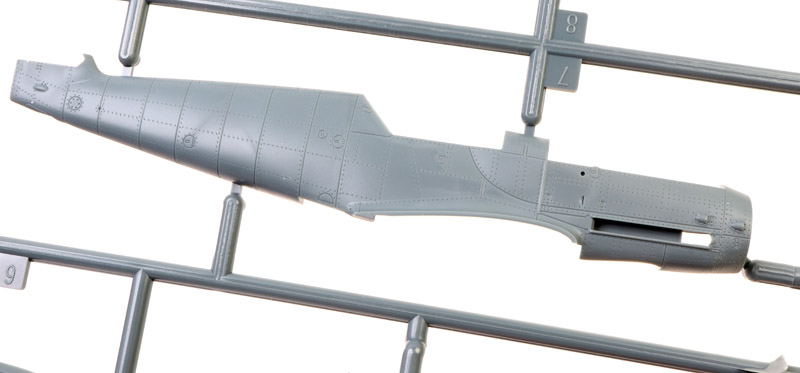
The rooves of the wheel wells are moulded in relief on the inside of the upper wing halves.

These sprues also offer the deep Fo 987 oil cooler housing that was typically seen on the Bf 109 G-10 and K-4, plus late-style gun troughs, tyres and an alternative tall fabric covered rudder with fixed trim tabs and Flettner tab.
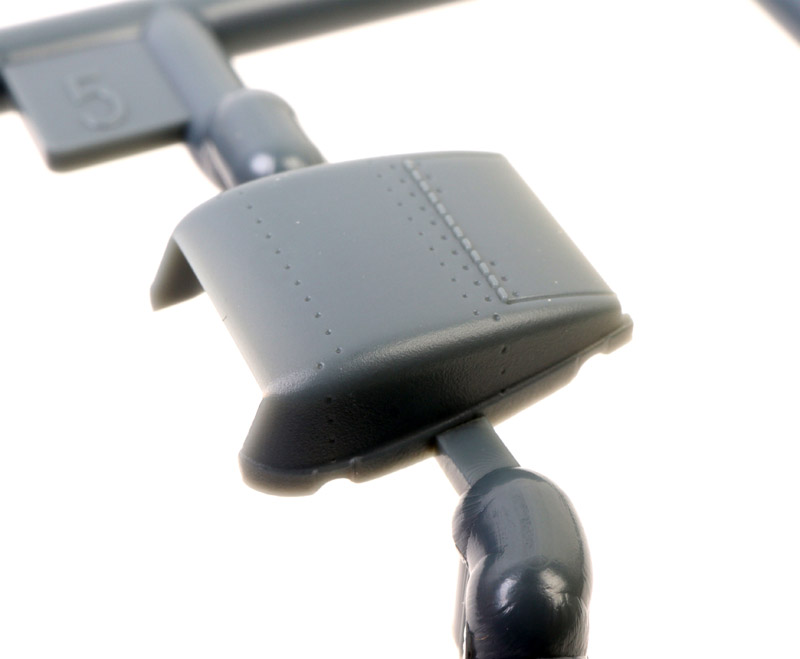
Stitching and fabric tape are depicted on fabric control surfaces.

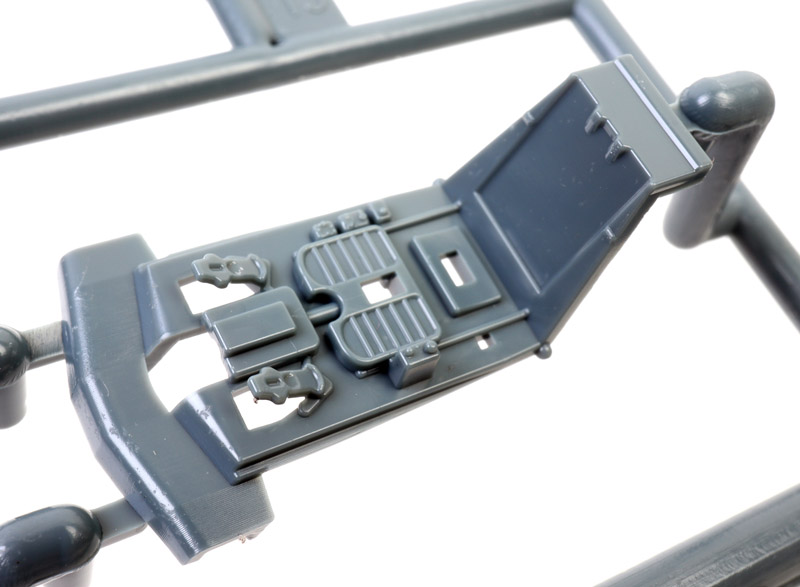
Partial raised cockpit sidewall detail is moulded onto the inside of each fuselage half. This is supplemented with additional plastic parts and colour photo-etch.
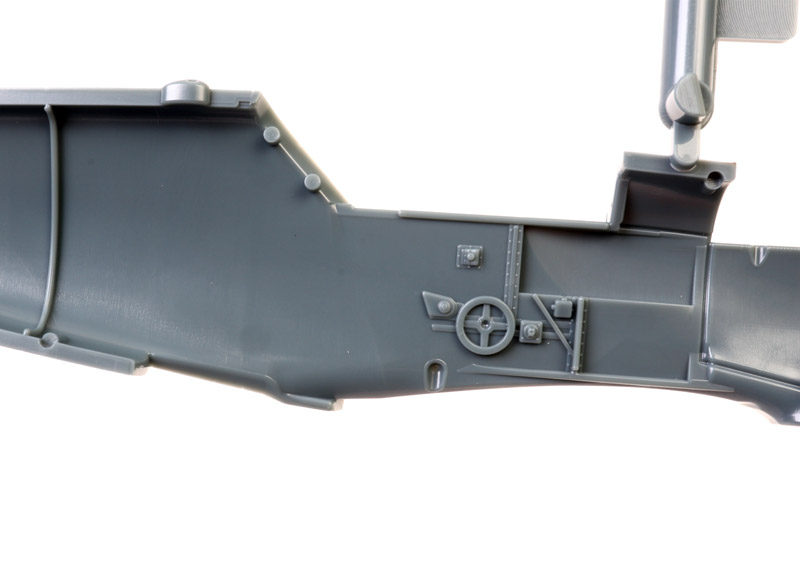
The plastic floor part has rudder pedals moulded in place. The kit supplies the conventional bucket seat and pressed metal backrest.
Two photo-etched frets are included. The first is a colour photo-etched fret that mainly focuses on the cockpit.
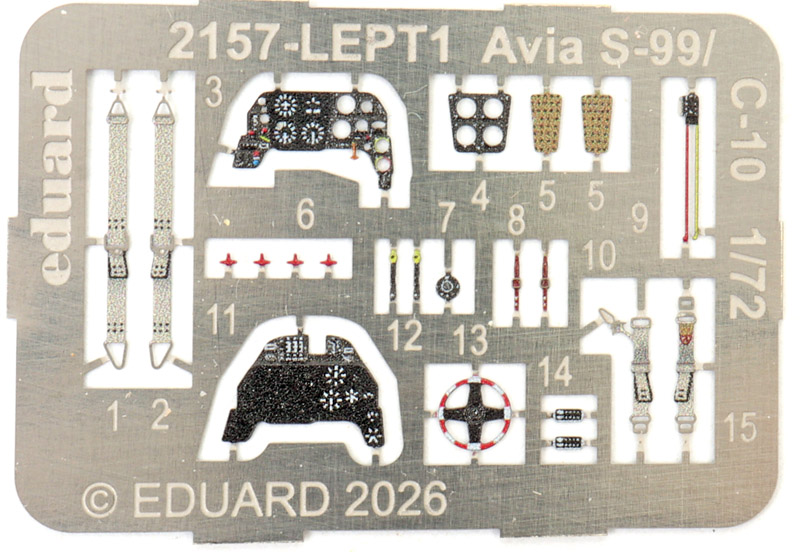
I particularly like the tiny red and white segments on the trim wheel - that will save some tricky painting!
The halftone shading on the harness straps look great, even in this small scale.
The second photo-etched fret is brass plated and features a myriad of parts for the exterior and the cockpit.
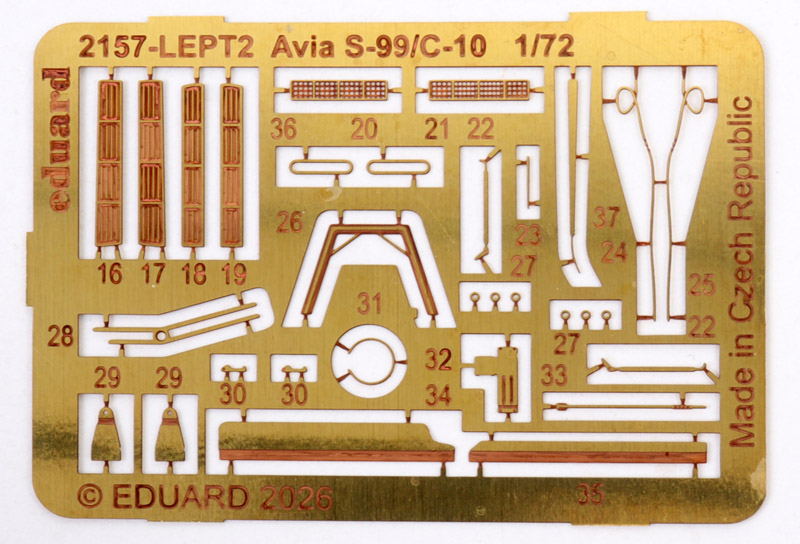
Alternative plastic parts are provided in case you don't like working with photo-etch. Two instrument panel decal overlays are also offered as an option to painting the plastic panel.
In common with its 1/48 scale cousin, this kit also features a clear fuel line for the starboard cockpit sidewall.

External details are included too, including mesh radiator faces.
The fuselage halves are full length. The vertical tail is a separate part. It features a long locating tab that should ensure robust fit.
Horizontal talplanes are moulded as a single part including the elevators.
Wings are conventional and will look familiar to anyone who has built Eduard's 1/48 scale Bf 109 G kits. The lower half is full span, while the uppers are split into port and starboard. Wheel well structural detail is moulded onto the inside of the upper wing. Wheel well and gear leg sidewalls are a simple single piece for each side.
Pay attention to the instructions here as you may need to drill out holes for the version that you are building.
Landing flaps, ailerons and leading edge slats are all separate parts. The flaps are designed to be displayed dropped, but it will be a simple matter to cut off the locating tabs and reposition them. it looks like the slats are designed to be dropped too, but once again if you'd prefer them retracted you can cut off the tabs.
The radiator flaps are moulded shut.
The pitot tube is moulded to the wing leading edge. This is inevitably delicate and Eduard has provided insurance in the form of a separate pitot tube on the sprues. I'll be cutting off the moulded-on parts and using this separate pitot tube for my build. Thanks Eduard!
Unlike Eduard's 1/48 scale Bf 109 kits, the undercarriage legs of these 1/72 scale Gustavs are moulded with deep locating pegs that should guarantee a robust join plus accurate splay and rake. I'd like to see this nice design feature upscaled for future Eduard Bf 109 releases in all scales.
26 clear parts are supplied on a single sprue. The parts are thin and clear.
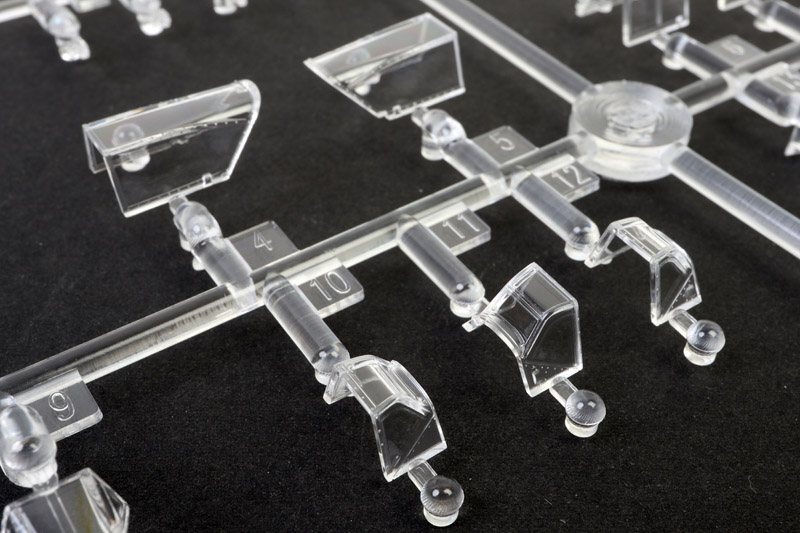
Clear parts include the three-part canopy, the Erla canopy, the clear cockpit fuel line, gunsight and wing tip navigation lights.
Markings
Markings are supplied for four colour schemes and markings.
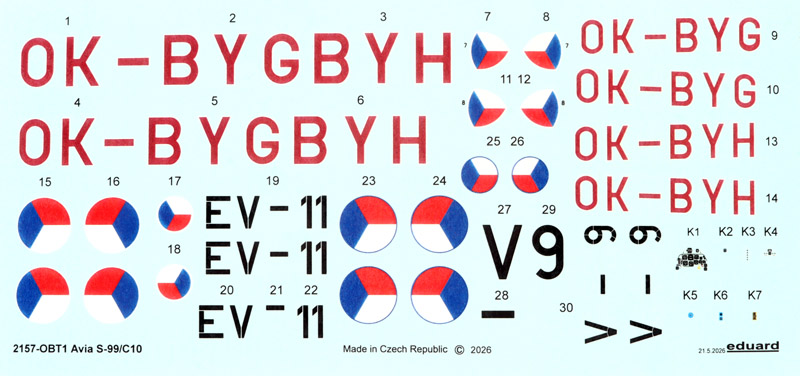
The unique and national markings are supplied on one decal sheet.
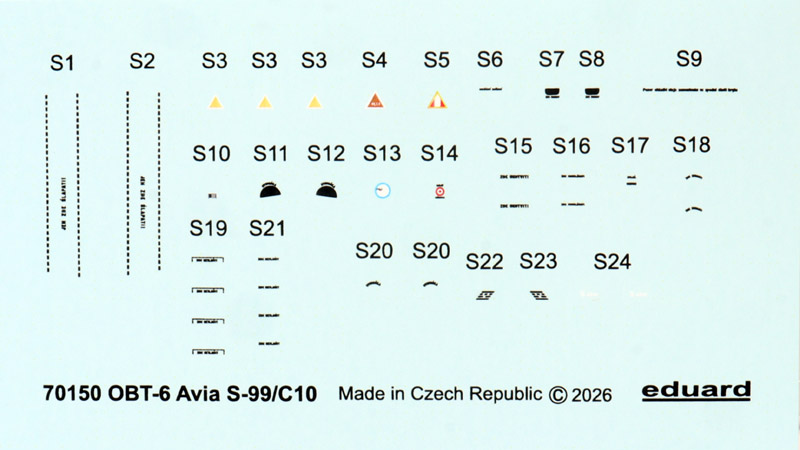
A separate decal sheet is supplied for stencils.
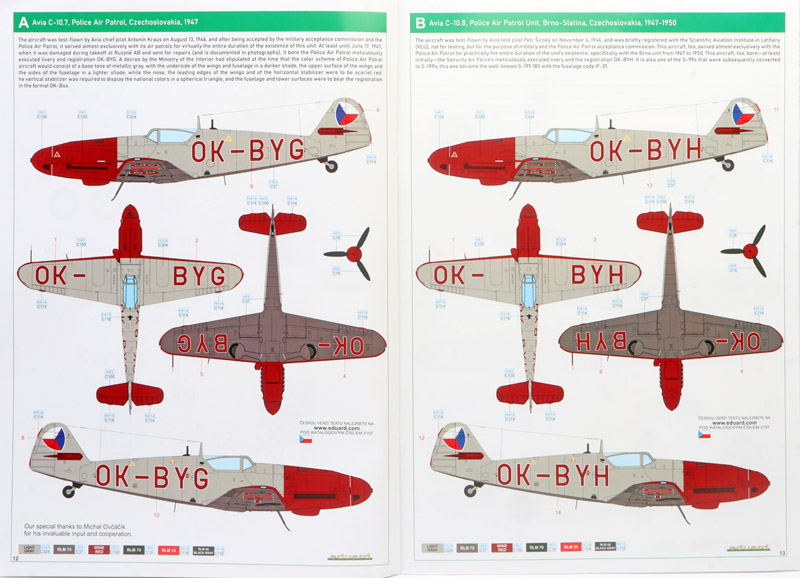
Two of the marking options are finished in striking Czech Police markings.
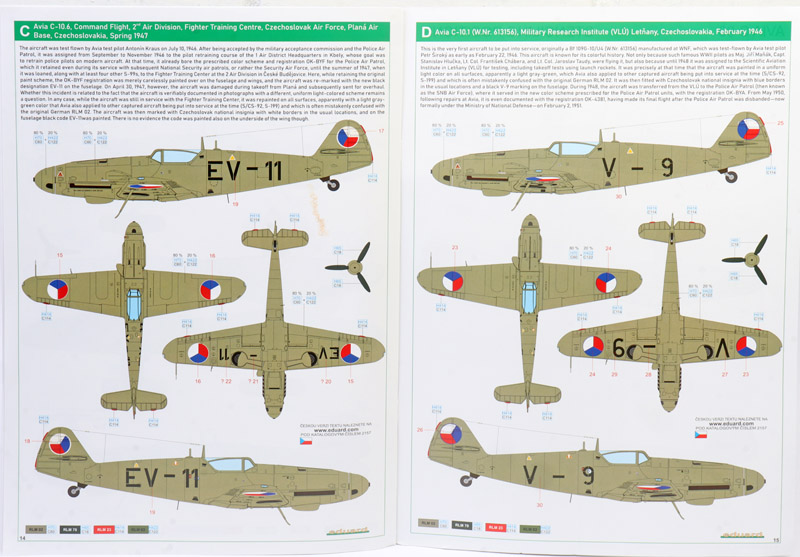
Eduard has once again made excellent use of its established 1/72 scale Bf 109 tooling, and this Avia C-10 / S-199 boxing adds an interesting post-war twist to the family.
The combination of finely moulded plastic, extensive photo-etched detail, useful options and four marking choices makes this an appealing package for both Bf 109 enthusiasts and modellers looking for something a little different.
Thoughtful touches such as the separate pitot tube and alternative plastic cockpit parts should also make for a straightforward and enjoyable build.
Highly recommended.
Thanks to Eduard for the sample.
Review Text Copyright © 2026 by
Brett Green
Page Created 25 September, 2026
Last updated
25 September, 2026
Back to HyperScale Main Page
Back to Reviews Page |
 Home
| What's New |
Features |
Gallery |
Reviews |
Reference |
Forum |
Home
| What's New |
Features |
Gallery |
Reviews |
Reference |
Forum |