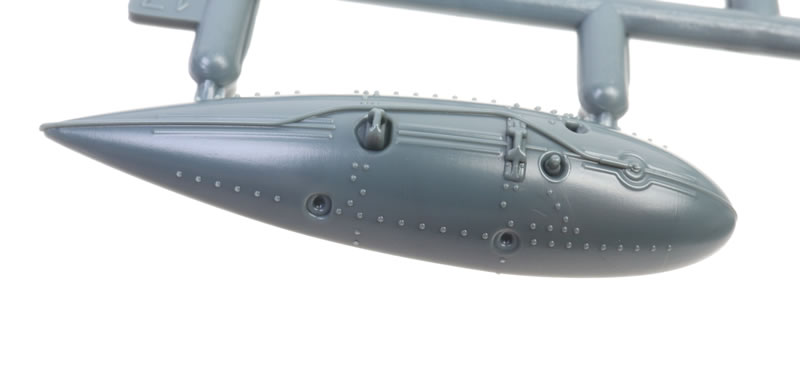
|
P-40K Warhawk
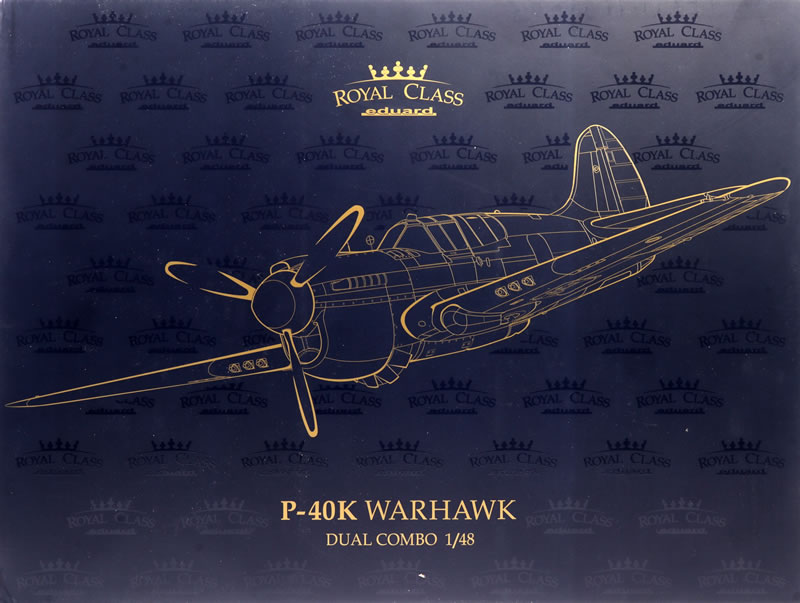
Eduard Royal Class Dual Combo
1/48 scale
S
u m m a r y |
| Description and Catalogue Number: |
Eduard Kit No. R0024 - P-40K Warhawk Royal Class Dual Combo |
| Scale: |
1/48 |
| Contents and Media: |
426 parts in grey plastic; 66 parts in clear; 8 conventionally moulded resin parts; 32 x 3d printed resin parts; two colour photo-etched frets; die-cut self-adhesive masks; fridge magnet; rubberised mouse mat; decals for eight marking options. 162 grey parts and two clear parts are marked not for use. |
| Price: |
£89.80 UK Price (£74.83 Export Price) plus shipping available online from Hannants |
| Review Type: |
FirstLook |
| Advantages: |
Parts for two complete models; very high level of detail; state-of-the-art surface textures; clever engineering and parts breakdown; 3d printed and conventional resin parts including two styles of seat with integrated harness straps, hollow exhaust stacks, diamond and block tread wheels six spoke and covered wheel hubs; covered and uncovered wheel well sidewalls; many useful options including multiple styles of propeller and canopy, large range of ordnance, aerials, avionics and more; high level of attention to detail. |
| Disadvantages: |
None noted. |
| Conclusion: |
Eduard has delivered another beautiful kit with their new 1/48 scale Royal Class Dual Combo big-tail P-40K.
Cockpit and wheel well detail match the superb standards of their best ever work.
Surface textures and the sheer number of optional parts are also class leading. This really is a Gold Standard Warhawk and a very versatile kit.
Well done Eduard and roll on with the series! |
Reviewed by Brett Green

The Curtiss P-40K Warhawk emerged as part of an ongoing effort to refine the P-40 series in response to evolving combat demands during World War II. By 1942, the need for improved performance—particularly at altitude and in hot climates—drove Curtiss to adapt the basic P-40E design. The P-40K introduced a more powerful Allison V-1710 engine variant and, in early production, a distinctive dorsal fin fillet to improve directional stability, which had been compromised by increased engine torque.
In terms of performance, the P-40K offered incremental improvements rather than a dramatic leap. Its maximum speed and climb rate were modest compared to more advanced contemporaries like the North American P-51 Mustang or Supermarine Spitfire. However, it retained the P-40’s strengths: a robust airframe, good diving capability, and effective firepower from its six .50-calibre machine guns. These qualities made it particularly effective in low- to medium-altitude combat and ground-attack missions.
Deployment of the P-40K was widespread, particularly in the China-Burma-India (CBI) theatre, where its rugged construction and reliability made it well suited to harsh operating conditions. It was flown extensively by the United States Army Air Forces, including units such as the famed Flying Tigers successors, who valued its durability and heavy armament. The type also saw service in the Mediterranean and Pacific theatres, often in ground-attack and close-support roles.
The P-40K also served with several Allied air forces. Notably, the Royal Air Force operated it as the Kittyhawk Mk.III, while Commonwealth units—including the Royal Australian Air Force—used it in the Western Desert and the Pacific. Other operators included Chinese Nationalist forces, who relied heavily on the type during the war against Japan.
It is time for 1:48 scale P-40 fanciers to celebrate.
Eduard's P-40K is the first time that a 1:48 scale big-tail version has been offered by any manufacturer with a fuselage free from inserts or surgery in order to deliver an accurate P-40K.
Huzzah!
Parts for two full kits are supplied in the big box.
Eduard’s all-new 1/48 scale Royal Class Dual Combo P-40K Warhawk comprises a whopping 426 parts in grey plastic; 66 parts in clear; 8 conventionally moulded resin parts; 32 x 3d printed resin parts; two colour photo-etched frets; die-cut self-adhesive masks; fridge magnet; A3 frameable cardbord print; decals for 12 marking options.
This parts count is not really anywhere near as high as might sound. Owing to the large number of options and parts for other versions, 162 grey parts and two clear parts are marked not for use. You can subtract another dozen or so for alternate parts.
Your spares box will love this one!
The actual number of grey plastic parts required per model will be around 92 - very manageable.
The point of differentiation between this P-40K and the earlier P-40E and P-4N releases is an all-new fuselage sprue.
The distinctive big tail looks correct in shape and bulk. It is moulded as part of the full-length fuselage halves.
Surface textures are as good as you would expect. I think in my reviews of the Eduard 1:48 scale P-40E and N kits that these Kittyhawks boast Eduard's best and finest surface textures yet. The P-40K does not disappoint in this respect. I built Eduard's 1:48 scale P-40E last year and it was a delightful experience.
I don't expect anything different from this kit.
The parts breakdown is quite conventional. Unlike the Hasegawa kit, there are no inserts in the fuselage or the wings.
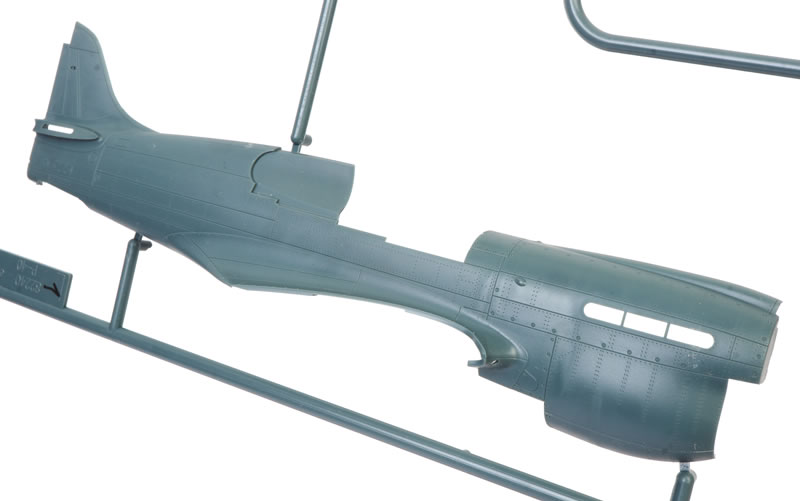
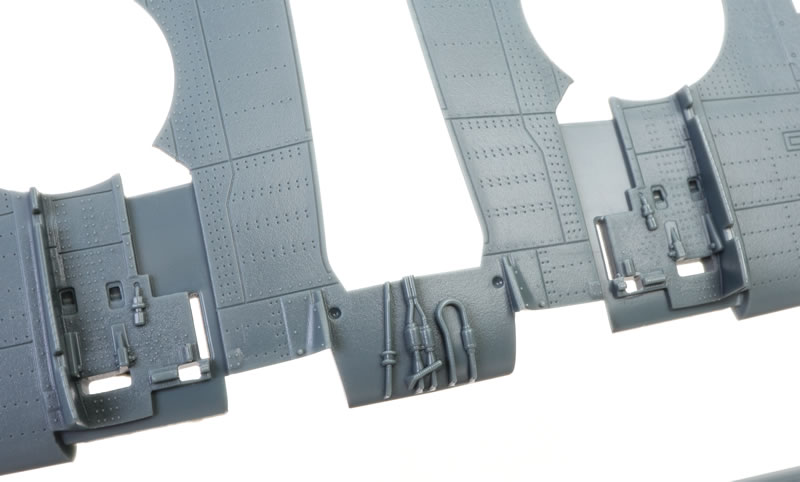
Surface detail is beautifully done with crisply recessed panel lines and selected rows of rivets. There are also a number of rows of subtly raised rivets where appropriate. The undercarriage retraction bays are a beautiful example of this symphony of surface textures.
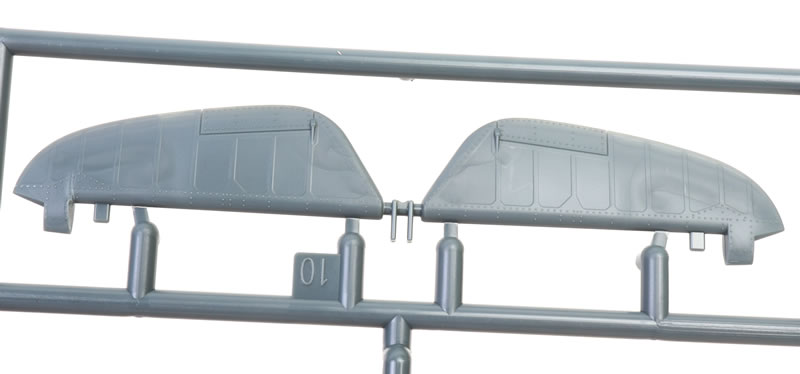
The fabric control surfaces feature restrained and convincing raised tape texture.
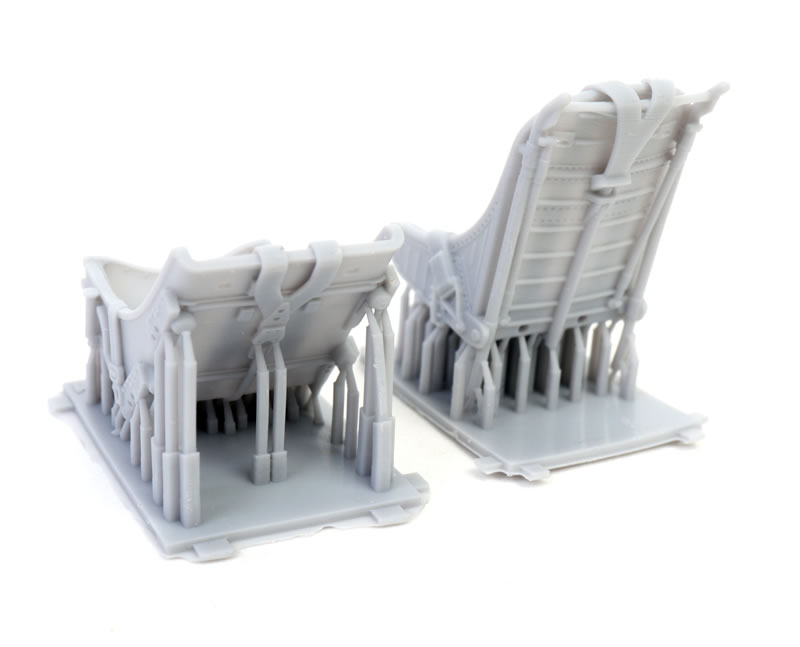
Royal Class releases usually offer a number of bonus and upgrade parts and this kit does not disappoint. First up are the 3d resin parts. Two pilot's seats are the highlight here. Two styles are offered - round top and square top.
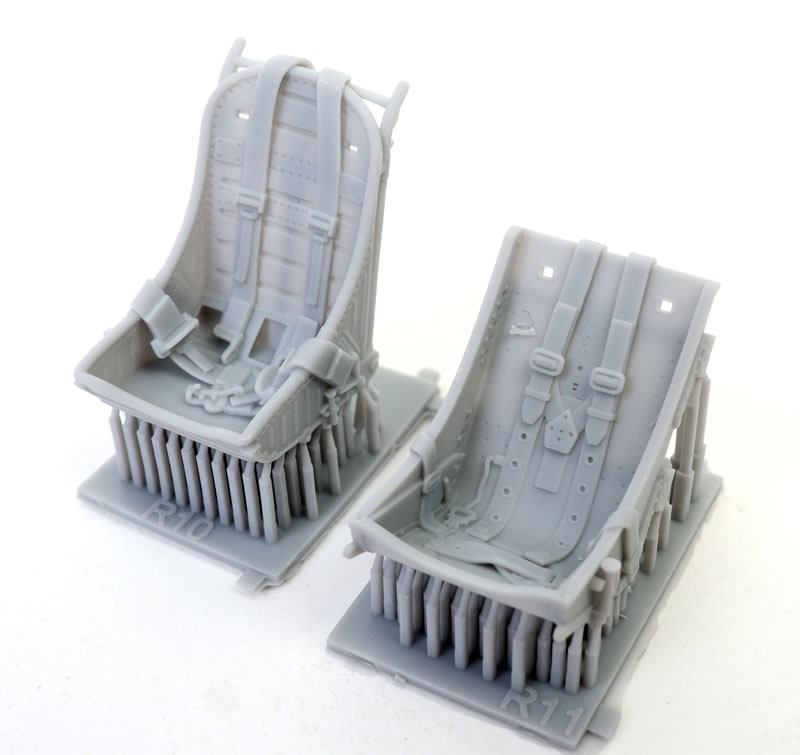
The harness straps have been printed in place and they look fantastic.
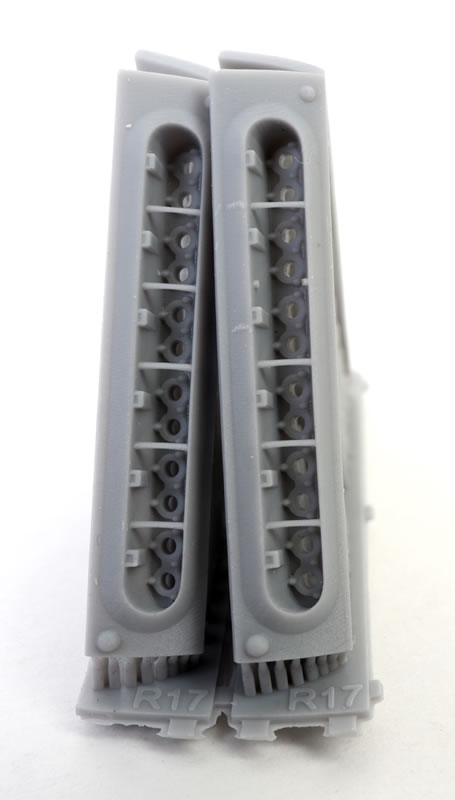
Next up is a full set of 24 individual and hollow fishtail exhaust stacks.

These feature raised weld beads.

They are mounted in a resin rectangle that will in turn fit into the side engine cowling.
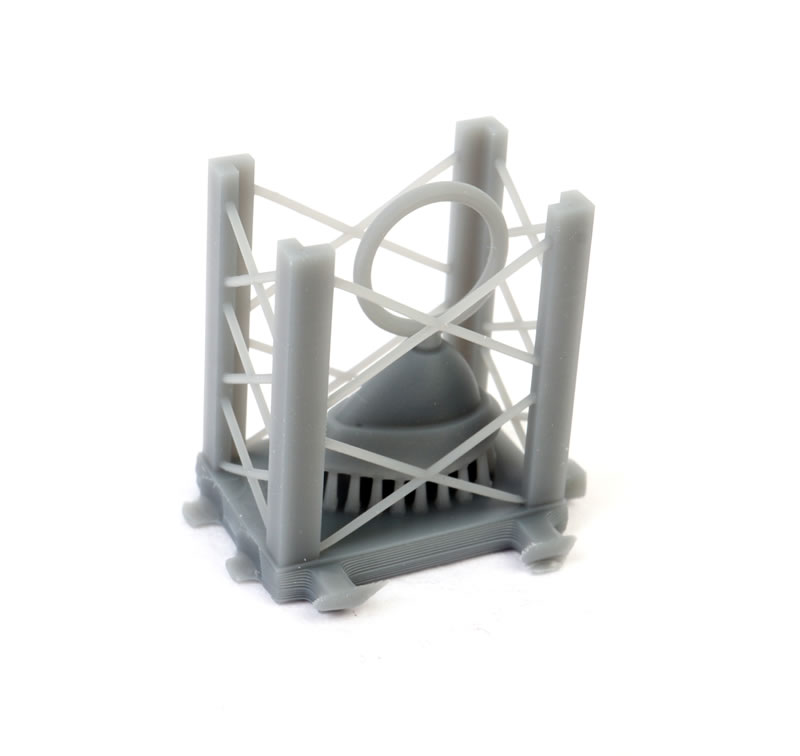
A finely 3d printed DF loop is also offered.
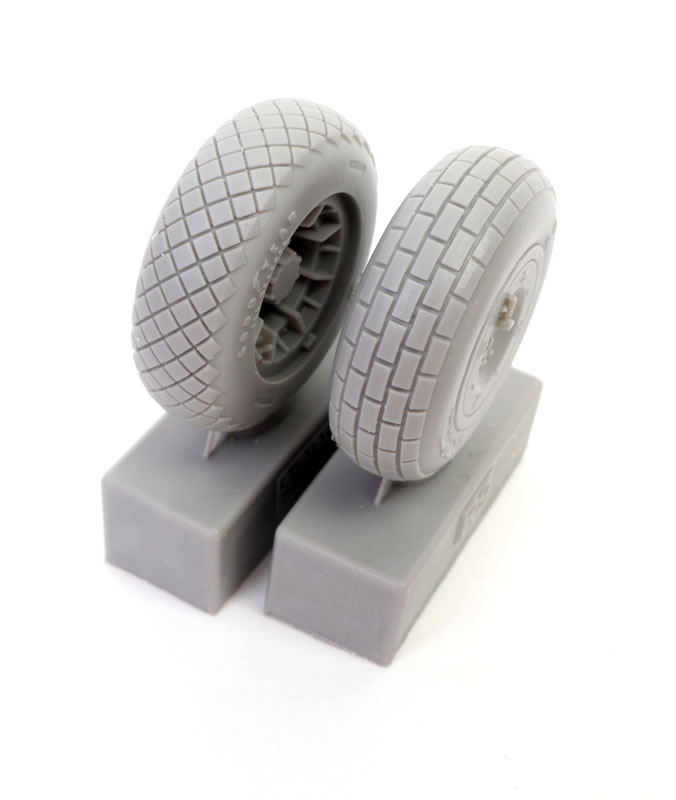
Rounding out the resin are eight conventionally cast wheels.
There is a pair of diamond tread and another pair of block tread wheels. The block tread tyres have raised lettering and a logo for Royal Airplane, while the diamond tread wheels are GoodYear.
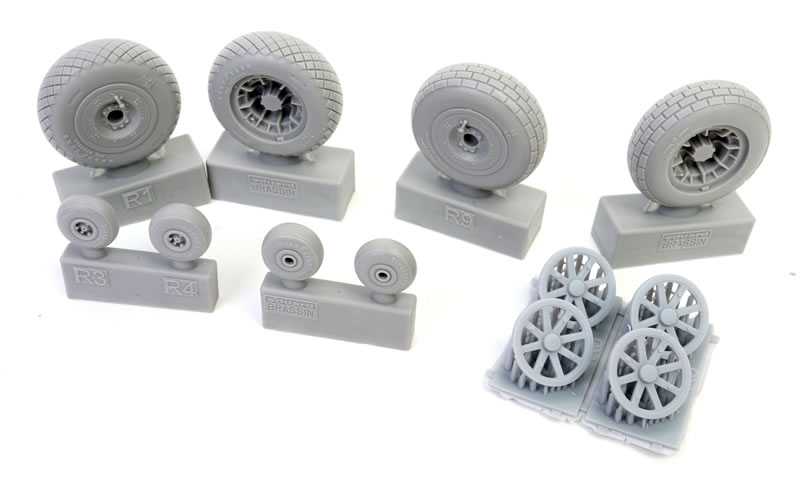
Each of the wheels are cast with a hydraulic connector and air valve.
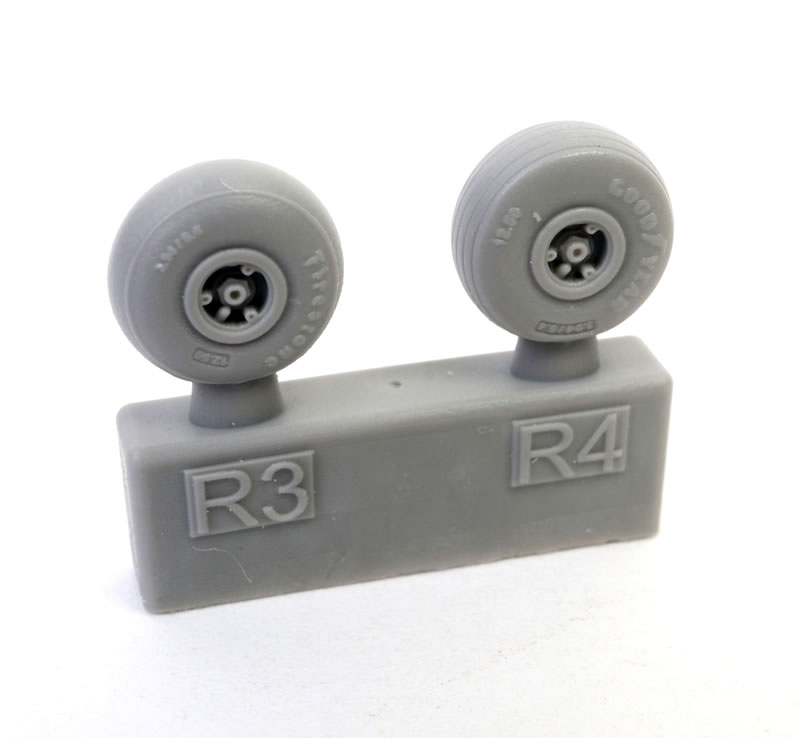
Two pairs of tail wheels are included too. Two are slick Firestones and the other pair is GoodYear with radial tread. Air valves are also moulded into these.
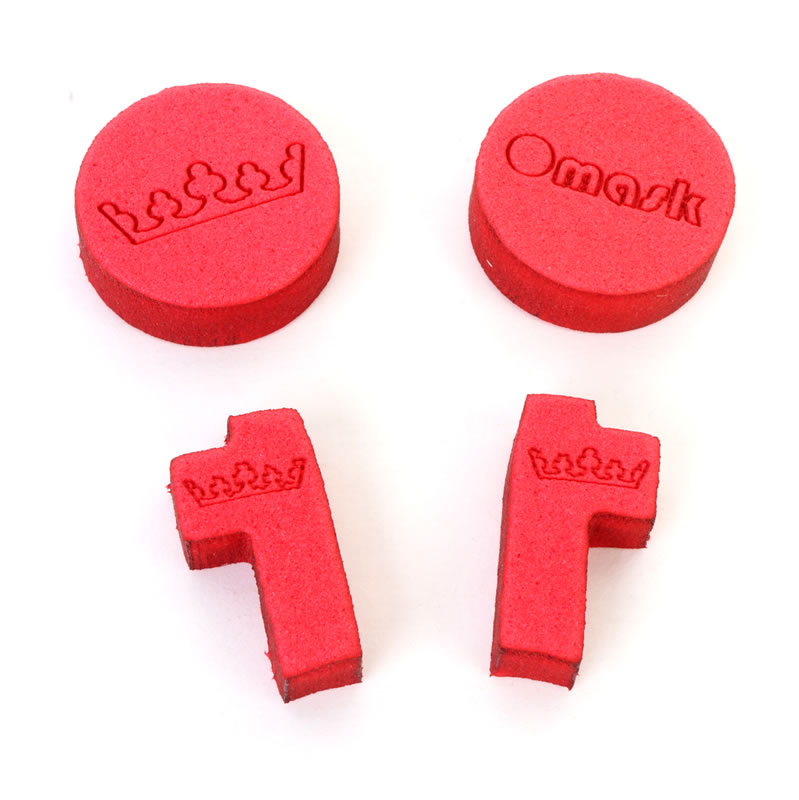
Next up in our box of goodies is a set of foam main undercarriage masks from O Mask. These simply press into the wheel wells after the wheel wells have been painted and before camouflage is applied. This is a handy little time saver.
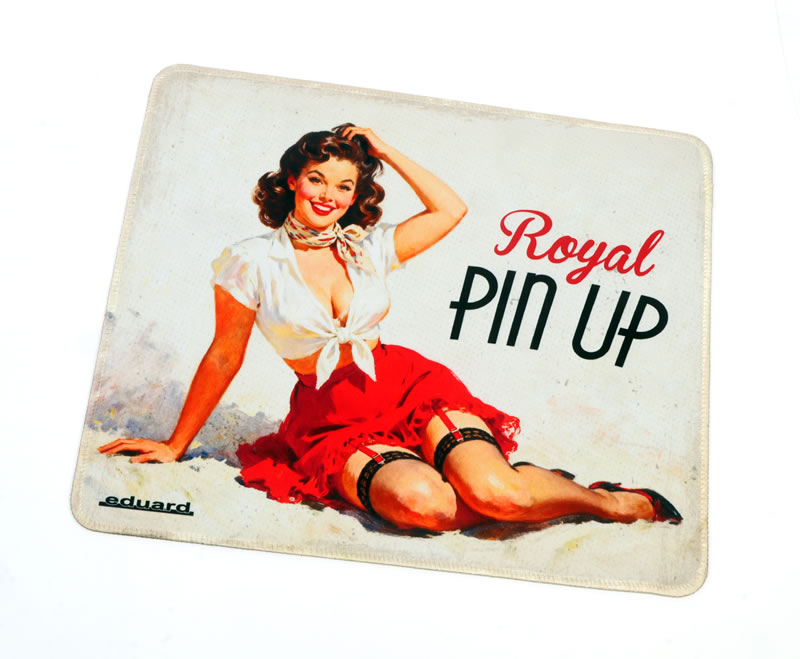
A mouse mat is also included, in the style of a Pin-Up beauty on an enamel tin sign. The mouse mat is a rubberised material.
Construction gets underway in the fabulously detailed cockpit. First up is the choice of the two resin pilot's seats, or the kit-supplied plastic seats with photo-etched harness straps. The choice is yours.
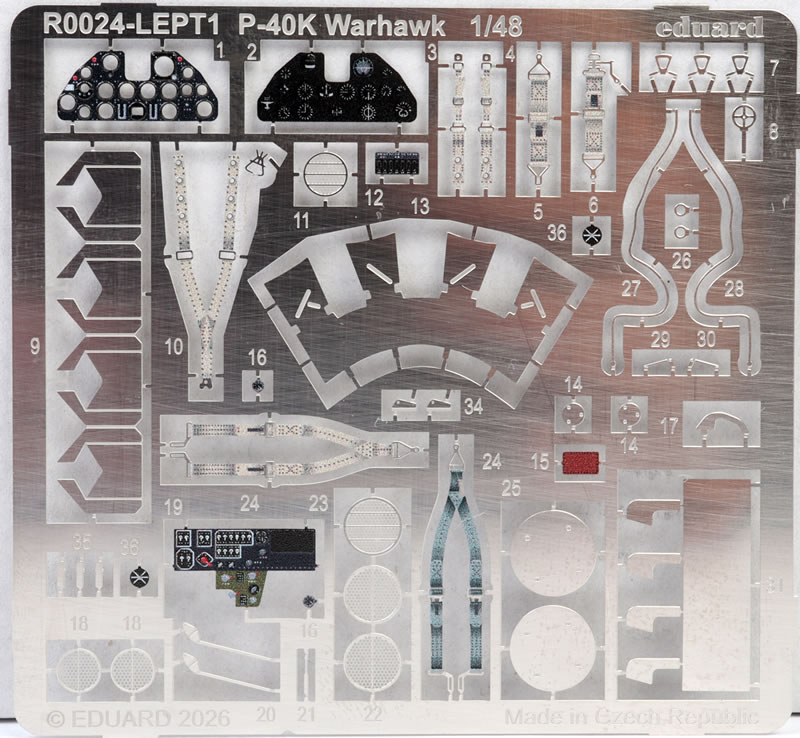
Photo-etched parts are also used for the instrument panel with raised bezels, quadrants and various handles and switch panels.
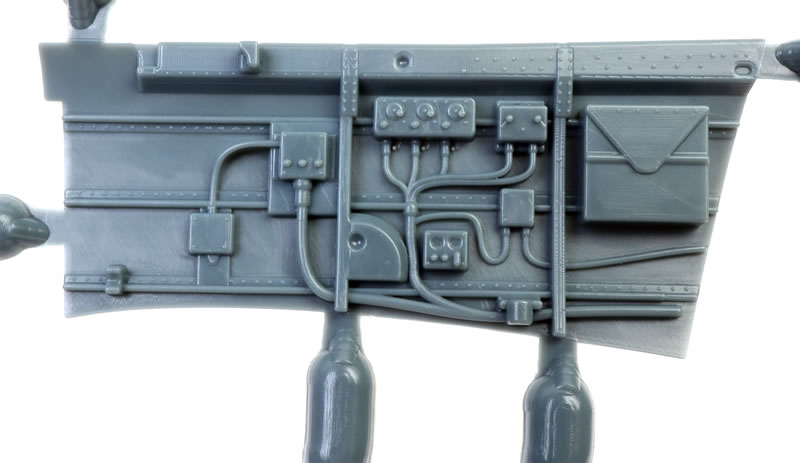
Alternative plastic starboard sidewall, four styles of gun sights and coaming are offered. I love the attention to detail here in the cockpit. A good example is the choice between two different actuator positions for the cooling regulator flaps. Part D7 is used for open flaps and D13 is used for closed flaps. I really like the quadrants and handles too.
The sidewall panels are separate parts.
Optional open and closed cooling flaps are supplied in photo-etched metal or plastic. Either will look good.
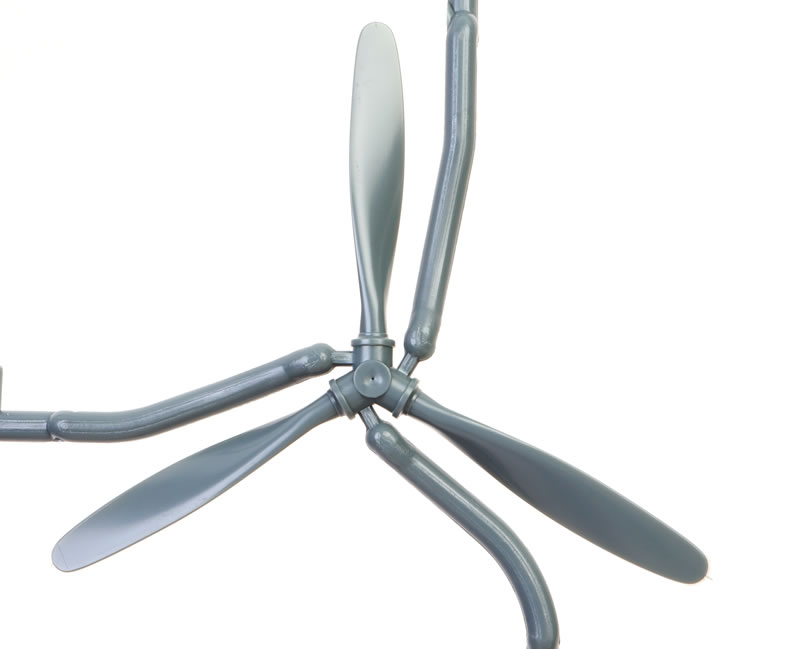
Two styles of propeller blades are supplied. The instructions are clear as to which ones are used for what marking options..
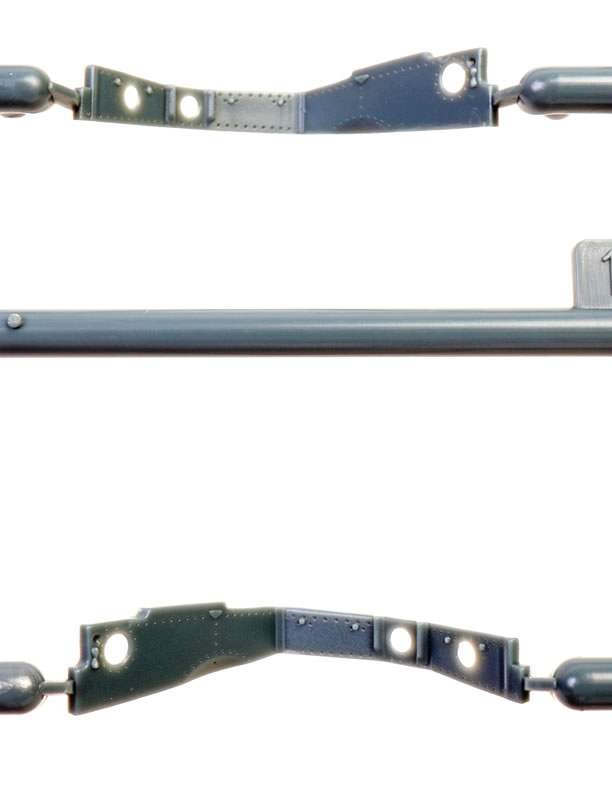
The main landing gear bay is beautifully detailed and the shape is correct.
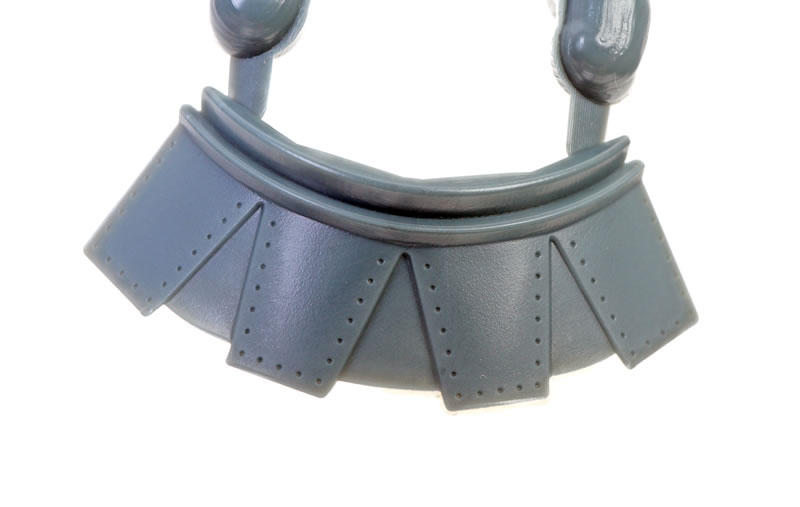
The kit provides parts for wheel wells with or without canvas covers. I am particularly impressed with the authentic textures and stitching for the covered option.
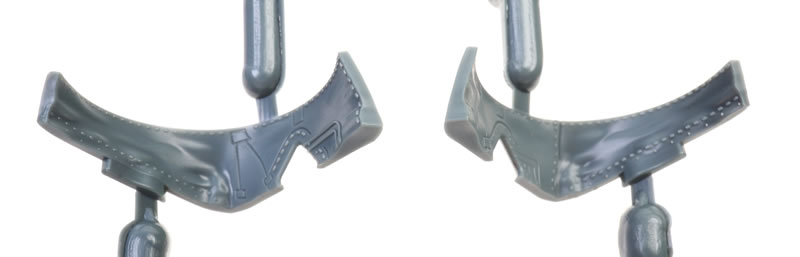
Ailerons and landing flaps are separate parts held in place with tabs. The flaps are moulded shut.
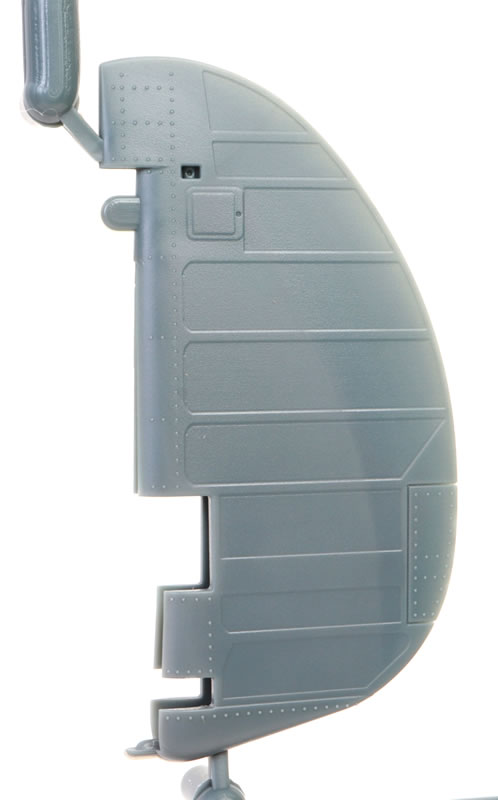
The rudder is a separate part.
The machine gun panels on the wing leading edge are recessed into the wing so no bulky separate inserts are needed.
Other options include multiple styles of metal drop tanks, 250lb US and British bombs, two triple rocket tubes, ten 5" HVAR rockets and more.
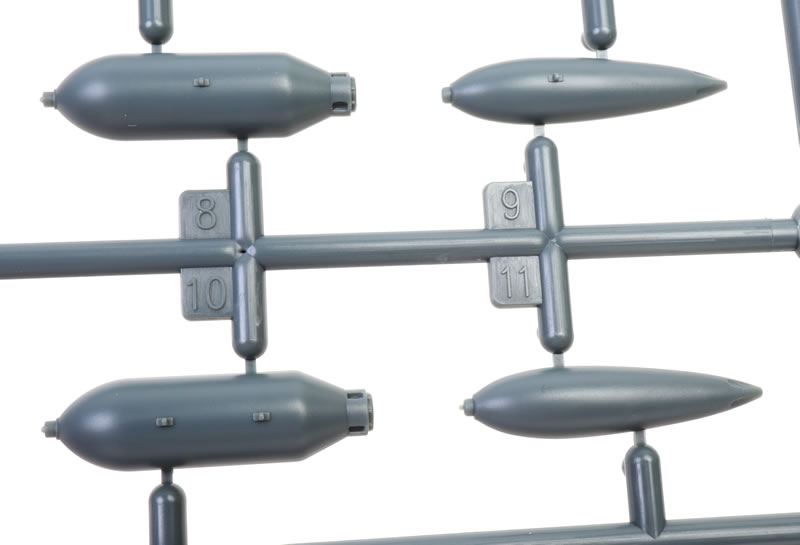
Many of these options are not required for the Warhawk markings supplied in this kit, but if you are impatient to build a later version, you'll find almost anything you could hope for right here on the sprues.
All transparencies are clear, thin and free from distortion. The windscreen is moulded with a small section of the upper fuselage, once again ensuring a clean join and painting demarcation.
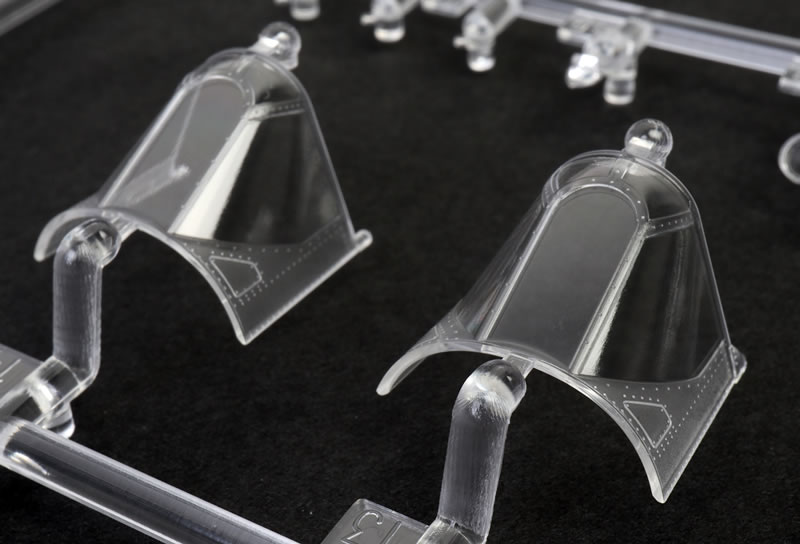
The side windows, a traditionally tricky area, are each moulded with a small section of fuselage that corresponds with panel lines. This will help avoid unwanted glue marks that are a hallmark of the P-40.
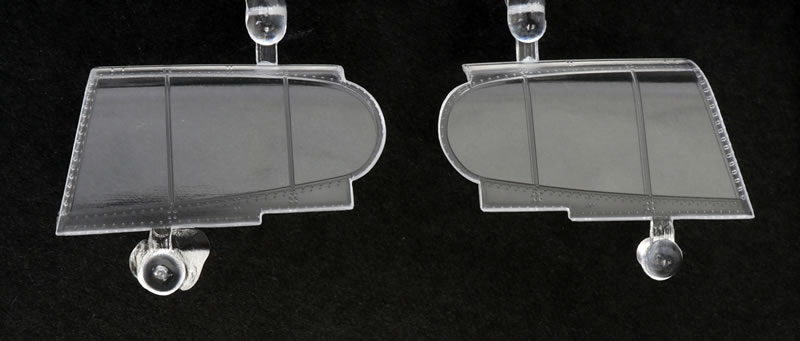
Both sprues offer options for open and closed canopies. I am pleased that Eduard has moulded the open framed top canopy panel as one piece with the side. This will help with alignment and strength.
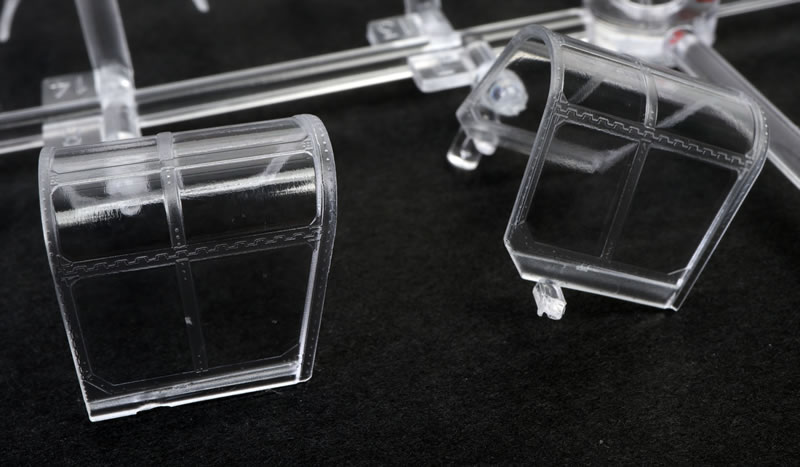
Gun sights, lights and lenses are also moulded as clear parts.
The instructions are called out over 28 pages. Considering this model has twelve marking options and lots of alternative parts, Eduard does an excellent job of keeping the modeller on track with regard to what parts are used for each of the schemes. The assembly diagrams help too. They are uncluttered and clearly supported by text notes.
Markings
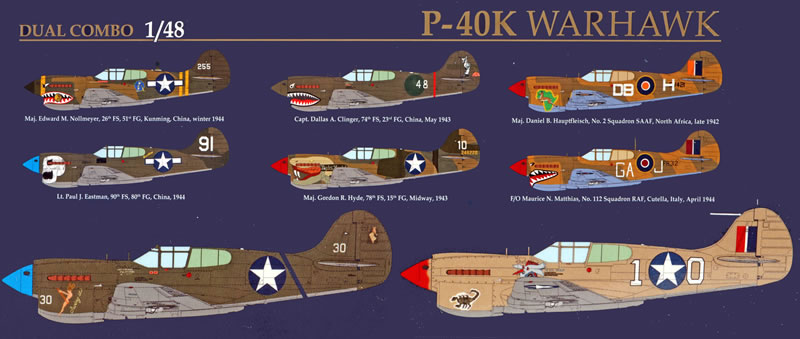
Markings are supplied for eight aircraft.
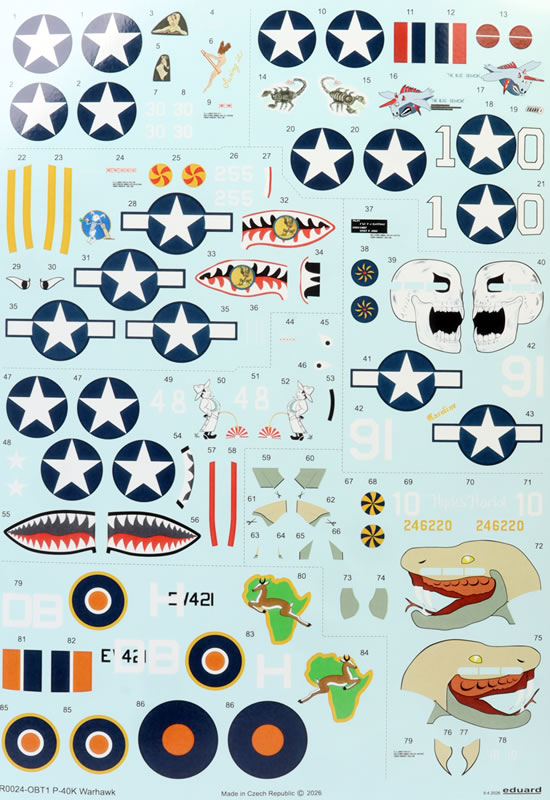
A nice selection of different colours and markings are offered. Here are the specific subjects:
-
Capt. Ray Melikian, 7th FS, 49th FG, New Guinea, 1942
-
Maj. Glade B. Bilby, CO of 64th FS, 57th FG, North Africa, spring 19442-9768,
-
Maj. Edward M. Nollmeyer, 26th FS, 51st FG, Kunming, China, winter 1944
-
Lt. Paul J. Eastman, 90th FS, 80th FG, China, 1944
-
Capt. Dallas A. Clinger, 74th FS, 23rd FG, China, May 1943
-
42-46220, Maj. Gordon R. Hyde, 78th FS, 18FG, Midway, 1943
-
EV421, Maj. Daniel B. Hauptfleisch, No. 2 Squadron SAAF, North Africa, late 1942
-
FR312, F/O Maurice N. Matthias, No. 112 Squadron RAF, Cutella, Italy, April 1944
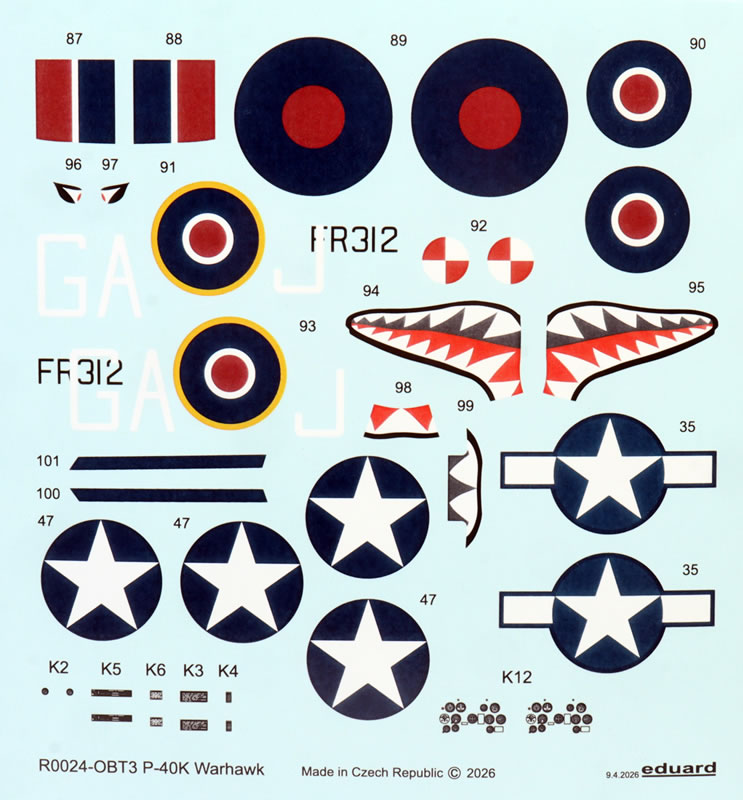
Decals are printed perfectly by Eduard.
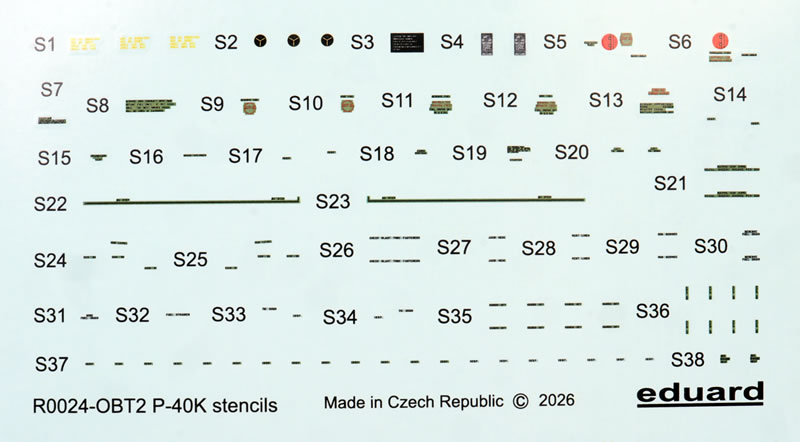
Two sets of stencil decals are supplied on separate decal sheets.
Eduard has delivered another beautiful kit with their new 1/48 scale Royal Class Dual Combo P-40K.
Cockpit and wheel wells are superb, matching the standards of their best work.
Surface textures and the sheer number of optional parts are also class leading.
This really is a Gold Standard Warhawk and a very versatile kit. Well done Eduard and roll on with the series!
Purchased by the reviewer.
Text and Images Copyright © 2026 by Brett Green
Page Created 25 May, 2026
Last updated
1 June, 2026
Back to HyperScale Main Page |
 Home
| What's New |
Features |
Gallery |
Reviews |
Reference |
Forum |
Home
| What's New |
Features |
Gallery |
Reviews |
Reference |
Forum |