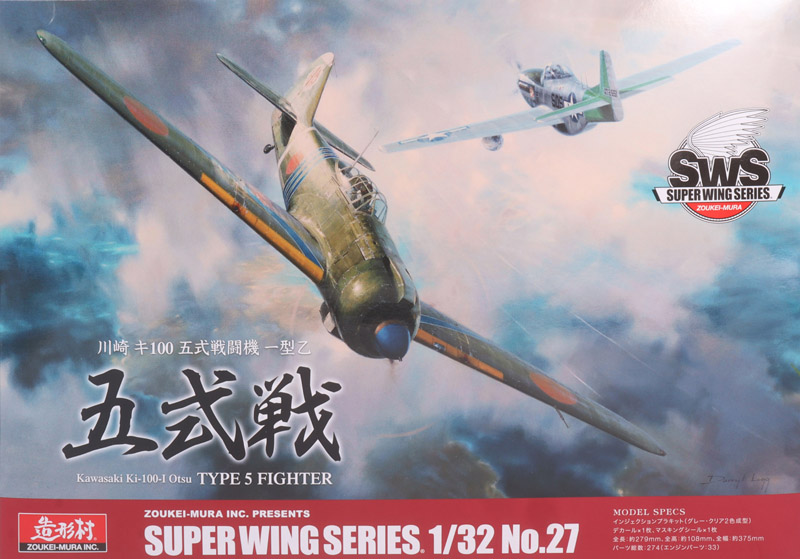
Zoukei-Mura Super Wings Series Kit No. 27 - Ki-100-1 Otsu
Contents and Media:
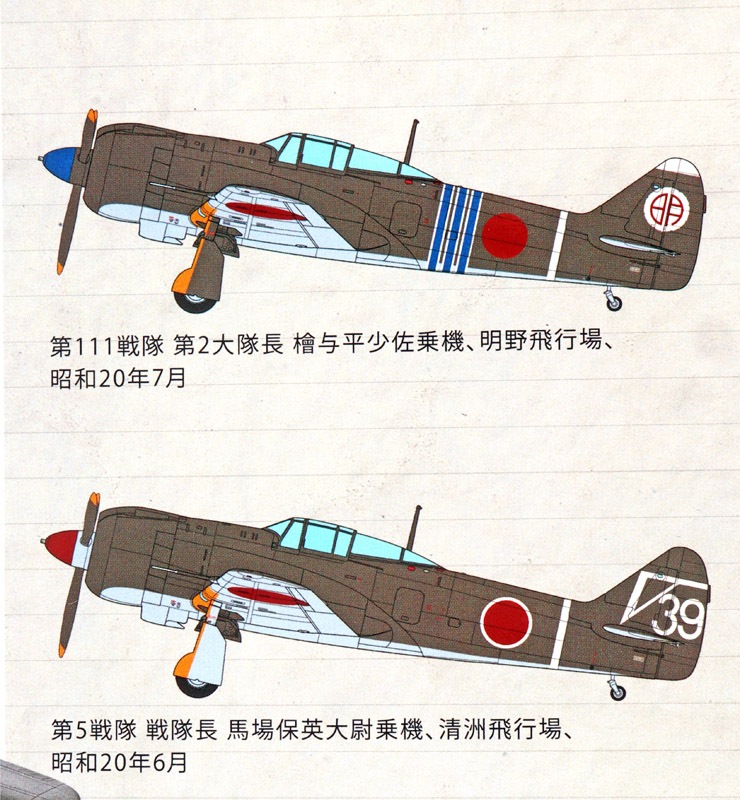
262 parts in grey plastic; 15 parts in clear plastic; self-adhesive die-cut masks; markings for two schemes; detailed 76 page illustrated instructions.
Finely recessed panel lines and fasteners; maximum level of detail including full engine, wing and cowl guns, radio equipment inside the fuselage and underlying skeletal frames; impressive attention to detail; wide selection of useful options; thoughtful design features; perfectly printed glossy Cartograf decals; accurate.
Disadvantages:
None noted.
Recommendation:
Zoukei-Mura’s 1:32 scale Ki-100-I Otsu is an impressive package, combining excellent surface detail with a comprehensive interior and engine assembly.
The opportunity to pose access panels open, expose the gun installations and display the finely detailed engine adds considerable scope for an engaging build.
The quality of the moulding, Cartograf decals, self-adhesive masks and exceptionally thorough instructions all contribute to a kit that promises to be as rewarding to build as it will be to display.
There is plenty here to satisfy the detail-conscious modeller. If you enjoy seeing what lies beneath an aircraft’s skin, Zoukei-Mura’s Ki-100-I Otsu should be right up your street.
Highly Recommended.
Reviewed by Brett Green
Introduction
The Kawasaki Ki-100 was one of Japan’s most successful late-war fighters, developed by adapting the Ki-61 Hien airframe to accept a radial engine. The Ki-61, known to the Allies as Tony, was unusual among Japanese Army fighters because it used a liquid-cooled V-12 derived from the German Daimler-Benz DB 601. Its streamlined appearance sometimes led Allied observers to mistake it for a Messerschmitt Bf 109.
Unfortunately, persistent reliability problems with the Ha-40 engine and difficulties developing its Ha-140 successor left Kawasaki with airframes but insufficient engines. The destruction of the Akashi engine factory in January 1945 made the situation worse.
Origins
Kawasaki’s answer was to install the reliable Mitsubishi Ha-112-II, an air-cooled radial producing approximately 1,500 horsepower. This required a redesigned engine mount and cowling but eliminated the radiator and coolant system. The first converted aircraft flew on 1 February 1945, and the results were sufficiently encouraging for production to begin almost immediately.
Variants
The Ki-100-I-Ko was converted from existing Ki-61-II Kai airframes and retained the original raised rear fuselage and framed canopy. The Ki-100-I-Otsu introduced a cut-down rear fuselage and bubble canopy for improved all-round vision. The Ki-100-II featured a turbocharged engine intended to improve high-altitude performance against B-29 bombers, but only three prototypes were completed.
Operational Service
The Ki-100 entered service in March 1945, just as American air attacks against Japan intensified. Its reliable engine, good handling and manoeuvrability made it a formidable opponent for contemporary Allied fighters, including the P-51 Mustang, P-47 Thunderbolt and F6F Hellcat. Although it lacked a decisive speed advantage, its handling made it particularly dangerous in turning engagements.
The fighter served with several Army Sentai, including the 244th, which defended the Tokyo area. However, fuel shortages, diminishing pilot experience and Japan’s deteriorating industrial capacity severely restricted its effectiveness.
The Radial Solution
The Ki-100 demonstrated the value of adapting an established airframe to a more dependable powerplant. It became one of the Imperial Japanese Army Air Service’s most capable late-war fighters, but arrived too late and in insufficient numbers to influence the outcome of the war. Its story remains an impressive example of engineering ingenuity under extraordinary pressure.
FirstLook
Zoukei-Mura's new 1:32 scale Ki-100-I Otsu comprises 262 parts in grey plastic, 15 parts in clear plastic, self-adhesive die-cut masks, markings for two schemes and detailed 76 page illustrated instructions.
This is Zoukei-Mura's first boxing of a Ki-100.
The parts breakdown suggest that we might see a razorback Ki-100-II in a Zoukei-Mura box at some time in the future.
This is an all-new kit but there are certainly family resemblences between this Ki-100 and earlier Z-M releases.
For starters, the parts breakdown is strikingly unique to Zoukei-Mura with full detail inside and out. This includes frames and stringers represented on the inside surfaces of the wings and fuselage.
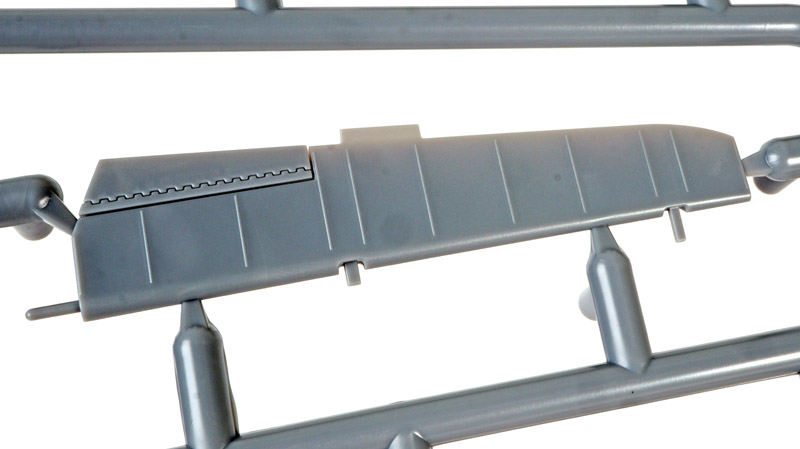
On the exterior, surface textures are restrained with fine recessed panel lines, hatches and minimal fasteners and rivets.
Interior details are equally impressive.
Zoukei-Mura supplies full engine detail. The engine is made up from 32 plastic parts described over 11 pages of instructions. The result will be very impressive. The instructions also note that you may build a display jig from the kit sprues.
The cockpit continues with a modest 15 parts, but this does not imply a lack of detail.
The plastic instrument panels are supplemented by detailed decals for dials, switches, stencils and more.
An optional clear plastic instrument panel is offered.
The kit includes two kinds of seat pans, one with lap belts and one without.
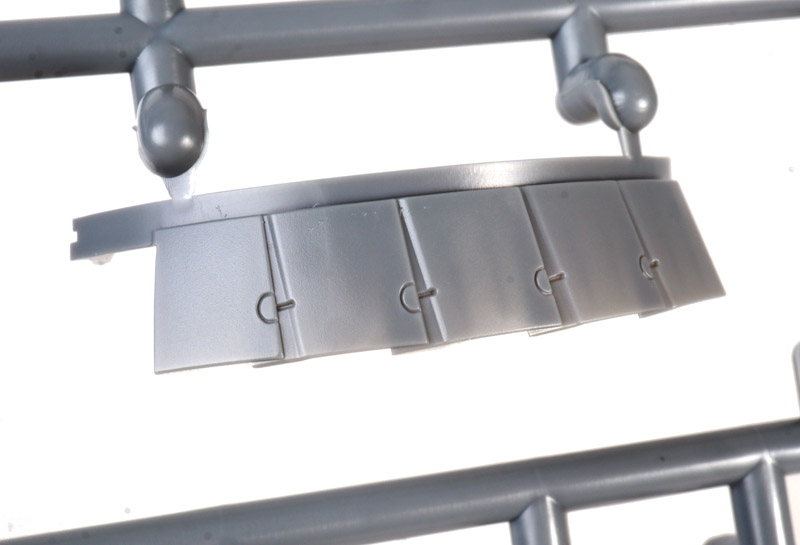
Separate parts are supplied for open and closed cowl flaps.
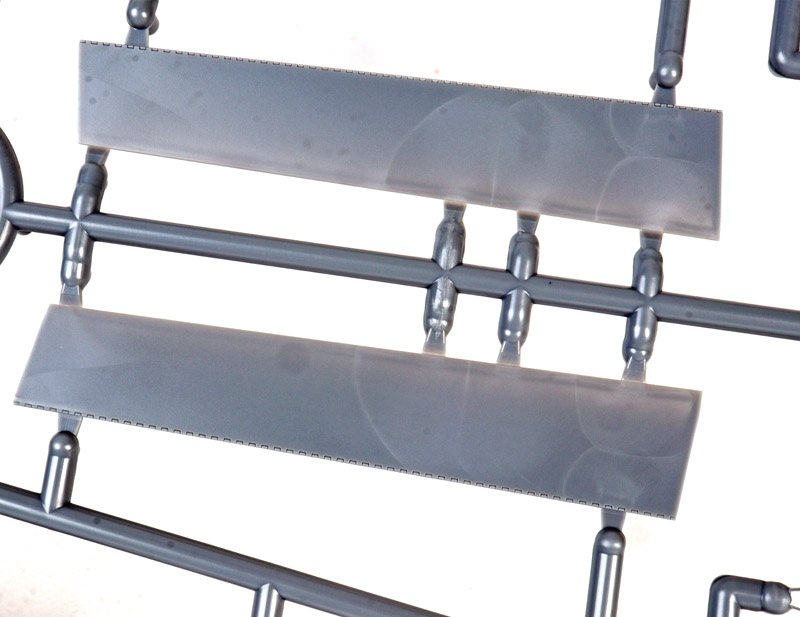
Control surfaces are all separate parts and may be posed to taste. Fabric texture is represented by raised ribs and subtle fabric tension. This looks convincing to my eye.
Flaps are supplied as one separate part each. They may be posed dropped or raised.
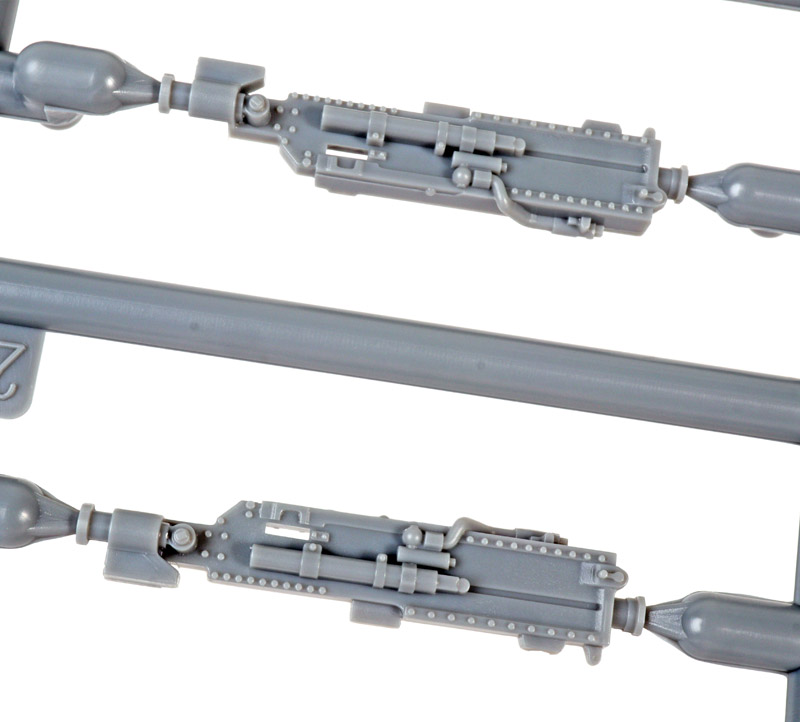
Full fuselage gun details are supplied. Included are the Ho-5 ammunition box, gun shelf divider, engine controls and the oil header tank. All access hatches may be posed open or closed.
The inserts conform with panel lines.
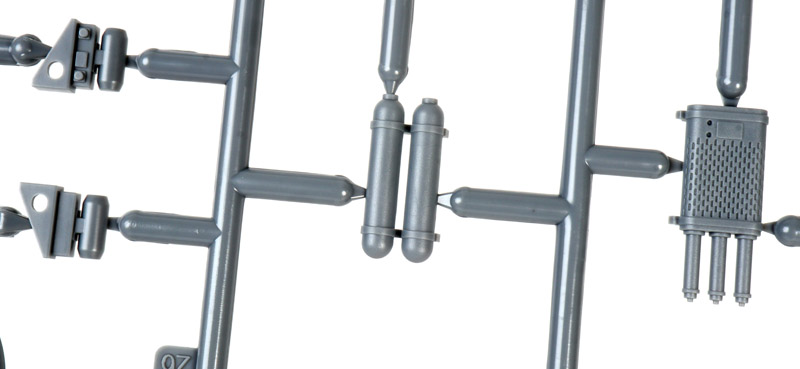
The mid-fuselage interior is quite busy. Oxygen tanks, radio transmitter, radio dynamo, bulkhead 7, hydraulic tank and two rear internal fuel tanks are included. The port side hatch may be posed open or closed.
The fuselage is split with the fin as a separate sub-assembly. Control surfaces are all poseable.
The clear sprue is thin and free from distortion. The canopy is supplied in three parts. The centre section may be posed open or closed.
Other parts on the clear sprue are navigation lights, gun sights, landing light cover and the aforementioned clear instrument panel.
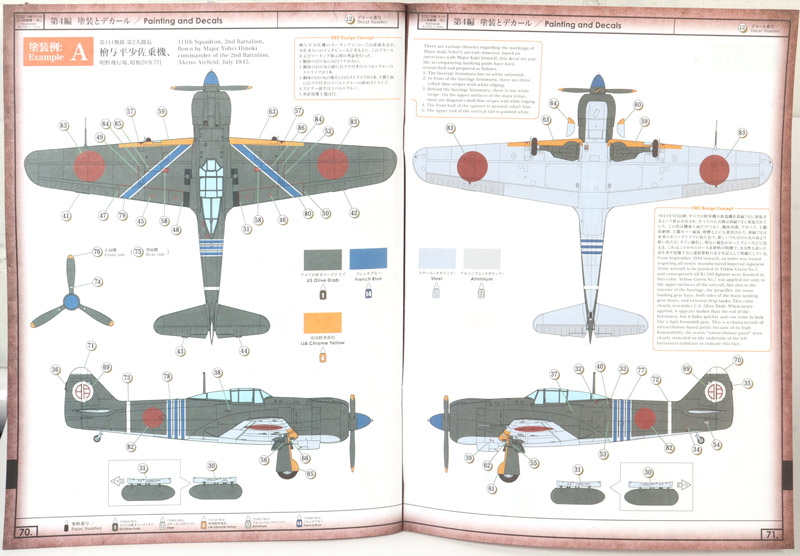
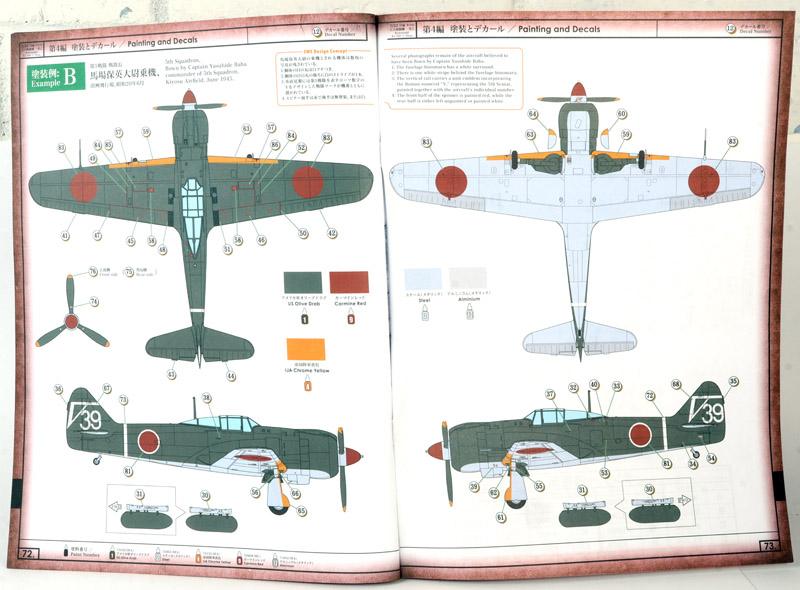
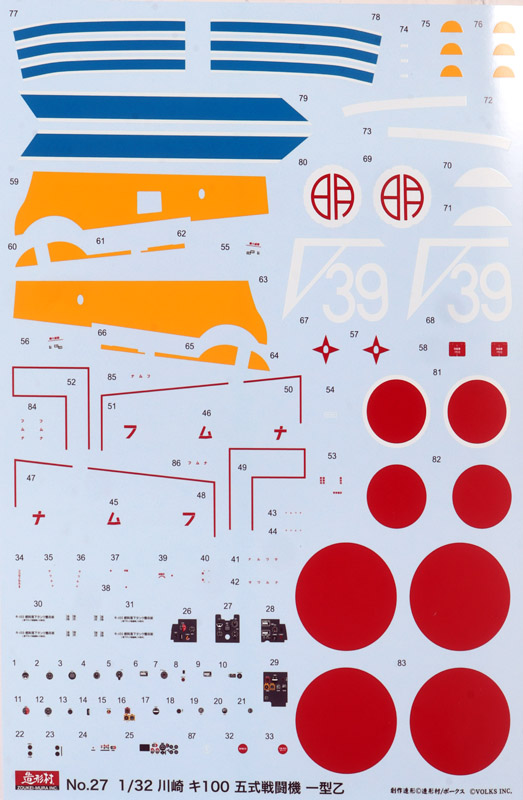
Decals are printed perfectly by Cartograf.
Stencil markings are printed onto the single large decal sheet along with the unique markings of the two subjects.
The inclusion of die-cut self-adhesive masks is a nice touch.
Instructions are exhaustive with 76 pages of illustrations and text. Zoukei-Mura offers multiple views from different angles to ensure that the modeller fully understands the sequence and position of assembly.
Conclusion
Zoukei-Mura’s 1:32 scale Ki-100-I Otsu is an impressive package, combining excellent surface detail with a comprehensive interior and engine assembly. The opportunity to pose access panels open, expose the gun installations, display the finely detailed engine adds considerable scope for an engaging build.
The quality of the moulding, Cartograf decals, self-adhesive masks and exceptionally thorough instructions all contribute to a kit that promises to be as rewarding to build as it will be to display. There is plenty here to satisfy the detail-conscious modeller.
If you enjoy seeing what lies beneath an aircraft’s skin, Zoukei-Mura’s Ki-100-I Otsu should be right up your street.
 Home
| What's New |
Features |
Gallery |
Reviews |
Reference |
Forum |
Search